Google Analytics

Sunday, May 22, 2011

Taipei MRT Signage

The MRT in Taipei is one of the great things about the city. The subway is clean, fast and efficient. All the stations have public restrooms, which is unimaginable for subway stations in New York. However, the signage system for the restrooms in Taipei's subway station is ridiculous and hideous.

Below is a picture of a restroom in a MRT station. For now, let's leave aside the design of the translucent screen and the potted plants, and just focus on the signs. For this little men's restroom, there is a total of 5 signs on the walls, plus one hanging off the ceiling not too far from where I took the picture. While Taiwan probably has the highest percentage of people with myopia, there is absolutely no need to plaster every surface with signs. Furthermore, why bother designing the walls when the signage contractor will "decorate" them anyway?

Tuesday, May 10, 2011

122°F Salmon

Reading about sous vide on the internet, it seems the easiest thing to cook is salmon. Therefore, that's what I decided to do. I used a cooking temperature of 122°F (50°C), based on a recipe I found. Some people such as Heston Blumenthal, Joan Roca, and Nathan Myhrvold use lower temperatures. I didn't because I was afraid my wife and kids will find the fish to be too rare.

I always like to get my two kids to be involved with the cooking. Often times, when the kids help make the food, they tend to want to eat it. With sous vide, since the temperature is low and there is no fire, the kids can actually be more involved: press the button to seal the bag, put the fish in the bag, press to seal and vacuum the bag, and drop the bag into the tub with warm water.


The salmon took around 12 minutes to cook in the water bath.


For the salmon I simply used some salt and pepper. Since I don't have a chamber vacuum sealer, I didn't want to add any liquid, such as olive oil, which would require the additional step of freezing the oil first.

The result of the salmon cooked sous vide was very good. I used to pan fry, steam, bake, and poach salmon fillet. With sous vide, the result is definitely different. First of all, the color of the cooked fillet looked raw. However, the fish was definitely cooked evenly throughout, which produced a soft and succulent texture. The texture is actually closer to smoked salmon. The flavor was very good and certainly more intense.

My two-year old happily ate the fish. I am not sure if it is because she helped with the cooking or because she actually likes salmon. Nevertheless, I cannot help but wonder if she gets accustomed to eating salmon cooked precisely by sous vide, will the texture and taste produced become her standard.

Sunday, April 17, 2011

Modernist Cuisine

I cannot remember when I first heard about Nathan Myhrvold's Modernist Cuisine, but since late last year I have been casually reading Modernist Cuisine's blog. I finally decided to pre-order the books on Amazon.com in the middle of February; one of the few times I purchased an expensive item without seeing it first in person. The books arrived in Taipei on April 11 via UPS.


Typically when I order books from Amazon.com to be delivered to Taipei, I don't have to pay import duty, as the costs of the books are usually small. With Modernist Cuisine, I was actually charged with a little tax, hence the orange C.O.D. sticker on the box in the above image. UPS said the shipment was too big and it didn't help the list price of the book was shown clearly on the box.

While the weight of the books is over 40 pounds, they were packaged extremely well for the shipment. With several layers of boxes, the books arrived in pristine conditions.


There are a total of six books with over two thousand pages. So far I have managed to just flipped through all of them and read a few parts.


Anyone interested should look through Modernist Cuisine's very informative website. I won't go into the details about the books except to say they are just stunning.


I will enjoy this set of books for years to come. For now, I cannot help but just marvel at this extraordinary achievement.

Monday, April 11, 2011

Arbitrage: Jean Paul Hevin Macarons

Jean Paul Hevin recently opened a boutique in Taipei. I was quite excited about it until I read on the news that a single macaron is priced at NT$138. I don't know who came up with the pricing, but that is just ridiculous.

A macaron at the Jean Paul Hevin boutique in Hong Kong costs less than NT$75 (HK$20). Below is a box of six macarons I recently purchased at the IFC branch, and they were delicious.


There is no reason the price in Taipei needs to be almost double the price in Hong Kong. I am tired of shops coming to Taipei and treating the people here like suckers.

Saturday, April 9, 2011

Forchetta: Stick a Fork in It

Recently a few of my friends held a birthday dinner at Forchetta (叉子餐廳), an "Italian" restaurant in Da-an district of Taipei. Though I have never been to the restaurant, I heard good things about the place from some friends. Hence, I was actually looking forward to trying it. Unfortunately, after the dinner I don't think I will go back again.

The dinner started with a soup that was lukewarm with flavors that were okay. However, the soup contained a small but whole lobster tail. Since I didn't want to be seen chewing off the lobster with my hand, I had to use a knife to cut it up. This must be the first time I ever used a knife to eat a soup. My feeling is the chef didn't want to cut up the lobster, he was afraid his customers wouldn't notice the ingredients that he was using if he did. The soup shows the chef doesn't think about how his customer will eat the food. The soup was also a sign that the chef cared too much about perception and was self-indulgent. It was not a good start.

The second course was a ravioli with a piece of abalone on top, served with a gorgonzola cheese sauce. The pasta was gummy, the abalone was rubbery, and the cheese overpowered everything. There are good reasons why most of the time Italians don't put any cheese on their seafood, and even when they do, it is not with a strong blue cheese. In this case, I just don't understand what the concept was behind the dish.

A sorbet was then served in a Chinese teapot filled with dry ice. It was a bit gimmicky, especially considering the size of the teapot in relation to the portion size of the sorbet. The presentation reminded me of the mango pudding dessert served by Yuji Wakiya at the defunct Wakiya restaurant in New York City.

My main course was a braised wagyu beef cheek, which lacked flavor. Different vegetables were served individually around the perimeter of the plate. One of them was a baby corn served in the husk. It didn't look good and didn't have much taste. The plating of the vegetables suggested the chef was looking for refinement, but didn't succeed. He should have started by serving tomatoes that are peeled.

After the main course, they served us some pasta with Chinese pickled cabbage and chicken. I was told this is the restaurant's signature dish. Having the pasta after the main course was another first for me. It was just weird; if the idea is to serve things in reverse, we might as well had the soup at the end like a Chinese meal. I didn't quite understand the pasta dish either. The pickled cabbage and chicken didn't do much for the pasta itself.

For dessert, my friends brought in cakes from an outside pastry store. The restaurant served the birthday cakes on paper plates with plastic forks. This was unfortunate, as people in Taiwan would say, "no fu." If one brings a wine from the outside, no restaurant would serve it in plastic cups. I just don't get it.

From what I gathered from many blogs, the restaurant has changed quite a bit from its early days. Rather than cooking simple dishes well, now it seems the chef is just trying to be "creative." The ingredients may be organic but the cooking wasn't. It doesn't feel like an evolution from his own career. Instead the dishes are reminiscent of other places, yet with flavor profiles and presentations that don't quite make sense. The dinner was not fusion, but confusion.

Friday, April 1, 2011

Precast Concrete Panels

I visited the construction site of my project in 中和市 a couple of days ago. The construction crew from Ruentex Group was in the process of installing the precast concrete panels.

There are two types of concrete panels on this project: bush hammered and image.

I have always liked the bush hammered finish, which provides the building with visual and tactile textures, like the fluting on a classical column. This type of finish was often used by Paul Rudolph on his buildings, the Art and Architecture Building at Yale, completed in 1963, is probably the most famous example. Bush hammered concrete seems to have gone out of fashion with the brutalist architectural style; recently people are more interested in the smooth finish of bare concrete. Hopefully, with this project there will be some renewed interests in bush hammered finish, as well as the architecture of the 60's and 70's; what's old may be new again.

The other type of panel is a newer type of finish. With the current technology, any image can be transferred on to the surface of the concrete. In our case this is done by casting the surface of the concrete with a computer-carved mold, which has grooves of varying depth and width. We are using an image of trees, which is meant to relate to the adjacent park. The image panels are conceived as an oversize frieze.


The building is scheduled to be completed by the end of the summer.  

Saturday, March 26, 2011

Popover with Apricot Jam

Whenever I want to make a last-minute dessert, I often turn to Jacques Pépin's Popover with Apricot Jam. The ingredients required for the dessert are usually found in my kitchen.

The dessert is quite simple to make: melt 3 tablespoon of butter in an oven-proof non-stick pan; mix half cup of flour with 2 tablespoon of sugar and a pinch of salt; then whisk in 2 eggs, half cup of milk, and 1/4 cup of sour cream (when I don't have it, I substitute with some yogurt); mix in the melted butter; pour the smooth batter back into the pan and bake at 400 degree F for around 20 minutes.

When the popover is done, warm some apricot jam in the microwave. Use a little cognac or some water (if the kids are eating) to thin the jam and spread onto the popover.


To make it look a bit fancier, I dust a bit of powdered sugar around the rim. Slice, serve and eat.


A warm and satisfying dessert, especially on a busy weekday.

Tuesday, March 22, 2011

Monocle Subscription

From time to time, I would buy an issue of Monocle magazine to read. I enjoy reading the stories and, besides, I like the look and the physical feel of the magazine. Recently I decided to purchase a one-year subscription, which is ten issues for £75. The great thing about Monocle is it doesn't matter where one lives in the world, the subscription rate is the same. Tyler Brûlé, the founder of Monocle, said, "We didn't think you should be penalized because of where you live.”

In certain parts of the world, unlike a typical magazine, it is actually more expensive to subscribe to Monocle than to purchase the issues at the newsstand. For instance, in London, the subscription cost per issue is £7.5 versus the newsstand price of £5; in the U.S., the subscription cost per issue is around US$12 while the newsstand price is US$10. Fortunately, in Taipei, the situation is reversed, where a subscription cost per issue is around NT$350 and the newsstand price is NT$550. Since I am always looking for opportunities to "save" money, I signed up and spent £75.

Tuesday, March 8, 2011

147.2°F Eggs

For my first attempt at sous vide cooking, I used Thomas Keller's recipe of Soft-Boiled Egg with Toasted Brioche and Bacon Marmalade in the booklet that came with the equipment. Technically, eggs are actually not cooked sous vide since they come with their own shells and don't need to be vacuum packed.

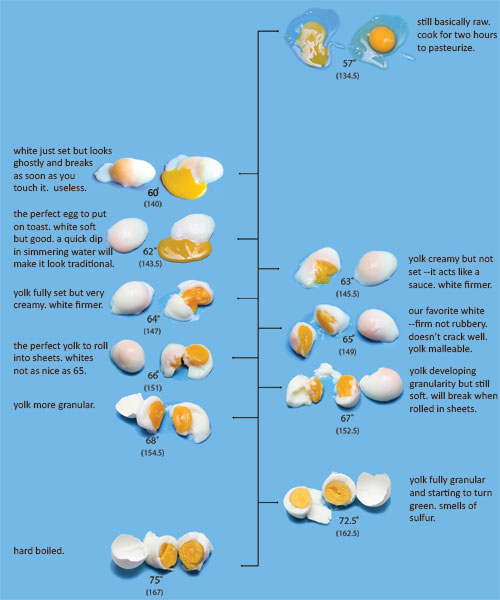
The recipe calls for cold eggs to be cooked in a water bath at the temperature of 147.2°F or 64°C for one hour. The circulator is very precise as it maintains the cooking temperature with ± 0.2°F stability.


While the eggs were cooking, I made the bacon marmalade: pan-fried minced bacon with blanched diced onions, cooked in a mixture of reduced vinegar and honey. I also toasted a store brought brioche.

I took the eggs out of the water after an hour. I cracked the shells open on one end and slipped the eggs out into a small bowl. Then with a large spoon the eggs were transferred very gently onto a plate. I also tried to make a quenelle of the marmalade and placed it next to the eggs.


The egg white is soft but relatively firm. The yolk is set yet very creamy.


The precision and consistency provided by the immersion circulator is really quite amazing. The blog, Cooking Issues, actually has a chart showing the results of eggs cooked at different temperatures. Now I understand why chefs are so enamored with sous vide cooking.