Google Analytics

Showing posts with label Review. Show all posts

Friday, July 25, 2025

Nobuo: Essentiality, Clarity, and Hospitality

 “Curry Rice!” my friend exclaimed as a white bowl was placed in front of him. A small mound of white rice with a dark and shimmering crescent-shaped pool of curry was an unexpected way to finish the savory portion of a tasting menu. Since the restaurant has one Michelin star, the curry rice is an elevated version of standard Japanese fare; the ingredient list is long, with mirepoix, fruits, spices, espresso, and dark chocolate. The rice was perfectly cooked, and the curry was full-flavored and complex. This is one of two signature dishes by Chef Nobu Lee at his eponymous restaurant, Nobuo, in downtown Taipei.

At first glance, the "ugly delicious" curry seemed out of place among the parade of delicately plated savory courses that came before. The seemingly simple yet complex dish is not only comforting but also reflects the essence of the restaurant and its chef—a confluence of different cultures and influences gained through travel and life experiences.

Curry may have its origins in India, but Japanese curry is not a direct descendant; rather, it was brought to Japan by the British. As curry migrates through the world, it gets reinterpreted. In Japan, curry was adapted to suit local tastes and became its own genre. Japanese-Taiwanese chef Lee spent his tumultuous childhood in Japan and later in Taiwan. Like many great chefs, he started as a dishwasher and worked in all sorts of places to make ends meet, including the American Club in Taipei. Eventually, he secured a job at L’Atelier de Joël Robuchon in Paris, which set the course for a career in fine dining. He was trained by some of the best French chefs in the world—Joël Robuchon and Yannick Alléno—by working in their restaurants in Taipei. He also worked in Australia and New Zealand. His journey ultimately brought him back to Taipei in 2019, where he became the head chef at Orchid restaurant. In 2023, he opened his own restaurant. Lee’s food is French in origin and technique, but many of the ingredients he uses are local. The flavor profiles are adapted to the local palate. Like Japanese curry, Lee has made French cuisine uniquely his own in Taipei.

The first time I had the curry rice—I’ve been to the restaurant twice—I didn’t know the dish offered unlimited servings. After I devoured the food, the server asked if I would like some more. Without thinking much, I said, “Sure.” It was only after I finished the second serving and the server asked again if I wanted another that I realized the curry rice was unlimited. The server said the chef wants to make sure people don’t leave the restaurant hungry. The idea that one can ask for more, and that there’s always more rice available, feels like eating at someone’s home. One senses less of the transactional nature of dining out and more of generosity.


The ambiance of the restaurant also feels a bit like a home. It is located on the ground floor of a seven-story apartment building in a residential neighborhood. The semi-enclosed entrance is partly paneled in wood, with painted green walls. A large potted leafy plant dominates the entry. Beside the dark brown wood door is a backlit crest reminiscent of Japanese family crests. Lee’s crest consists of three oysters and three knives. In the press, Lee said that a chef he once worked with told him, “The world is your oyster.” This phrase has stayed with him ever since, serving as an inspiration for freedom, adventure, and the pursuit of his dreams.


Step inside the wooden door, and you’ll find a shallow credenza in a small foyer—like entering someone’s apartment. In contrast to the exterior, the color palette inside is light, with off-white walls and ceiling and light wood floors. The dining room is one continuous space with two distinct areas. The back area, with 12 seats, is more defined and does not have a direct view of the open kitchen. The front area, with six seats, is directly in front of the kitchen. The kitchen workstations are perpendicular to the space, and there isn’t a barrier between the kitchen and the diners—not even a kitchen pass; it feels almost like eating at a kitchen table. Even though the kitchen is open, it is not noisy at all. In fact, there’s an efficiency and rhythm to the movement that feels almost choreographed.


There are no views to the outside, but a window made of glass bricks allows some natural light into the space during the day. Framed artworks hang on a few walls, and the soundtrack is mostly mid-century hard-bop jazz. The wooden tables are covered with white tablecloths that are slotted into the table at both ends. The table setting is minimal, with just the essentials: a white napkin, a simple water glass, and a menu. Even though the restaurant is small, the tables are nicely spaced. The overall feel is very pleasant.


Maybe because I visited Tokyo just before coming to Nobuo for the first time, the restaurant feels slightly Japanese in terms of its look and scale. I can’t quite explain this perception, but I can easily imagine Nobuo being located in Tokyo’s Minato ward.

Lee stated that his food is based on the principles of "simplicity, purity, and honesty." I’ve been to the restaurant twice in the last six months—once for lunch and once for dinner—and I understand these ideas and see them reflected on the plates. However, these terms can feel a bit nebulous. Instead, I suggest three other words to describe Lee’s food, as well as the restaurant: essentiality, clarity, and hospitality.

Simplicity in fine dining often belies the complicated and arduous process behind it. This is similar to minimalist architecture, where achieving something that looks simple and effortless often requires more work and greater expense. Also, simplicity in food doesn’t mean a lack of complexity in flavor. Instead of “simplicity,” I prefer the term essentiality to describe what Lee is trying to achieve—and, for the most part, accomplishes. His dishes are pared down and free of extraneous components.

The two scallop dishes that Lee served in succession during my dinner in June are good examples. The first was a cold scallop dish: the scallop was lightly smoked, served with almond purée, and topped with caviar. The dish certainly looked simple and elegant, but it was rooted in refined technique. The beauty of this simplicity is that the diner is not distracted and can truly focus on the taste of the ingredients.


The warm scallop dish is Lee’s other signature offering: scallop mousse. The mousse is molded in the shape of a small scallop shell, steamed, and served with a butter-based sauce. Visually, this dish is even simpler, with a very limited color palette—yet it is strikingly beautiful. It’s a good example of how you don’t need sharply contrasting colors, excessive ingredients, or tweezer-plated components to create a stunning dish—a rare sight in Western fine dining in Taipei. The texture of the scallop mousse is light, and the sauce is wonderful. The dish’s simplicity demands technical precision because there’s nothing to hide mistakes. It was a memorable dish, and I can see why Lee always keeps it on the seasonally changing menu.


For the majority of the meal, Lee manages to keep things simple and essential, but occasionally a dish doesn’t quite work. The main course at my dinner in June—A5 wagyu beef au poivre with conch—was a bit too complicated and lacked balance. I love the idea of surf and turf, but in this case, the two didn’t really go together. The conch provided a different texture from the beef but felt more decorative than complementary. The sauce was well made but a bit too heavy—not just for the conch, but for the beef as well. Each of the components was well prepared, but they didn’t seem to come together cohesively. I can see that, since this is the pièce de résistance, the chef wanted to do more, but this dish didn’t have the same quality of simplicity or essentiality as the seafood dishes. To make matters worse, the dish comes with a NT$600 supplemental charge.


Lee’s second principle is “purity,” which implies the state of not being mixed with anything else. Again, I understand Lee’s intention, but this idea is hard to apply to food, because cooking inevitably involves some manipulation of nature’s bounty. Instead of purity, I prefer the term "clarity", which suggests coherence, intelligibility, and the ability to see—or taste—clearly. There is clarity in Lee’s intention, execution, and flavor profile. You know what you are eating, and the food is not overly manipulated for the sake of technique.

The best example is the fish course: snapper with green peas. The fish was cooked simply and looked beautiful. The petit pois that accompanied the fish were vibrant in color and nicely prepared. The sauce, made with clams to enhance the flavor, was delicate and well balanced. One could see and taste the freshness. There was clarity in both the plating and the flavors. It was a wonderful dish.


Another example is the octopus, which is slow-cooked, seared, dusted with shrimp powder, and served with a shrimp- and tomato-based cream sauce. 


The pre-dessert is also a good illustration of clarity. Lee serves a quenelle of tofu ice cream with tofu purée. The appearance and flavor of the pre-dessert are clean and simply very nice.


The same cannot be said about the main dessert, which takes inspiration from the Japanese treat sakuramochi. It consists of red bean paste, diced wax apple, white chocolate ganache, cherry blossom leaf, sake sorbet, and a sake-based sauce. The ideas of essentiality and clarity both eluded this dessert. Of all the dishes I had at Nobuo, this was the one I disliked the most. Maybe I don’t have a strong enough memory of eating sakuramochi to appreciate the idea behind the dessert—or maybe I was just hoping for some actual mochi. The flavors of each component were fine, but they didn’t seem to come together to form a cohesive whole. For me, this dessert was too clever or complicated for its own good.


Aside from the dessert, the other thing I don’t like at Nobuo is the bread service. In between the two seafood courses, the server brought out a small kugelhopf with a dipping sauce. This is one of the few things I didn’t enjoy at either of my meals. I didn’t understand the purpose of the dish or its place in the sequence. This is essentially the bread course, but the kugelhopf was too crumbly—more like a cake than a bread. It was hard to eat with the sauce served on the side. I also disliked the size—it was too small.


I wish Lee would serve a larger kugelhopf meant to be shared, like Gabriel Kreuther does at his eponymous restaurant in New York City. It’s always nice to break bread with dining companions. Actually, what I’d really prefer is for Lee to serve some bread at the beginning of the meal. Many of the dishes at Nobuo come with well-made and delicious sauces. It would be so much better if I had some bread to sop up those sauces.

Maybe Lee doesn’t have the personnel or capacity for an in-house bread program. There’s nothing wrong with outsourcing bread—even some Michelin three-star restaurants do that. Perhaps Lee thinks serving bread is too Western, or that it doesn’t pair well with the curry rice at the end. But if not bread, how about some flatbread (餅)? Starting from the amuse-bouche, there are so many nice sauces that deserve to be sopped up.


Lee’s third principle is “honesty.” Frankly, this is a bit hard for a diner to judge. Take the pricing of the meals at Nobuo: lunch is NT$2,880 plus 10%, and dinner is NT$4,280 plus 10%; lunch has three fewer courses than dinner. Are these prices honest or fair? I can only say the pricing seems reasonable based on the experience and in comparison to other similar restaurants in Taipei. Or take the origin of the ingredients—I can only assume the information provided is accurate. Therefore, instead of honesty, I prefer the term hospitality, which means the act of being friendly and welcoming to guests.

You can feel the hospitality the moment you walk into the restaurant. You are welcomed by a friendly server who helps open the door. As you walk past the open kitchen, the chef says hello. After sitting down, the restaurant manager, Heidi Peng, comes to greet you and explain the menu.

Hospitality doesn’t mean being overtly friendly. For instance, when dishes are brought to the table, there are no lengthy explanations—just the essentials. The servers don’t hover over you or interrupt your conversations with your dining companions. But throughout the meal at Nobuo, you always feel well taken care of by the staff. The service feels more European than American or Taiwanese. The staff is sincere and very professional.

Another example is the aforementioned unlimited refill of curry rice. Chef Lee is a serious cook—you won’t find him laughing it up or sitting down with diners in the dining room. But you can see his hospitality and heartfelt desire to make sure guests go home with full stomachs.

At our dinner in June, we were celebrating my daughter’s birthday. The restaurant put a candle on her dessert plate. But they went one step beyond the standard practice: Peng gave her a birthday card signed by the entire staff. It was her first time at Nobuo, yet the gesture made her feel at home—as if she were with old friends. However, to make it even more personal, Peng might consider handwriting the entire note, similar to what luxury hotels often do.


After we finished our dinner, we said goodbye to the chef and staff. A server walked us to the door and waited with us until our ride arrived. He saw us off with the same way you might find in Japan.

A few weeks ago, a friend asked me what memorable meal I had recently. Without hesitation, I said Nobuo. The meal wasn’t perfect, but it was a highly enjoyable experience. The majority of the dishes were on point and delicious. The weaker dishes—the final savory course and the main dessert—were those where Lee seemed to be trying to do too much or felt the need to present a multi-component creation. The result was dishes with well-executed parts, but lacking an integrated whole where everything felt essential.

Given that the restaurant serves only one tasting menu for all guests, I wish Lee would experiment with some large-format dishes. Instead of conceiving and cooking only individual tasting portions, why not create dishes that are shared and even cut and served table side? For example, rather than serving each diner a small kugelhopf, why not bake a large loaf of bread and slice it at the table—similar to what Alain Ducasse does at some of his fine dining restaurants. For savory courses, there could be en croûte dishes or whole poultry meant for sharing. Large-format dishes would provide variety and perhaps lessen the need for overly complicated main courses.

Since Nobuo is a small restaurant, difficult to book, and offers only a seasonal tasting menu, it’s not the kind of place one can visit weekly or even monthly. Nor is it a restaurant that promises extravagance or grand cuisine. Rather, Nobuo is a very good and compelling restaurant where you can have a great experience, enjoy beautiful ingredients cooked with skill,   and gain insights into the world that Lee came from.

Monday, June 5, 2023

Clover Bellavita by Jean-Francois Piège

Jean-Francois Piège is a famous chef not only in his home country of France, but amongst the foodies in Taiwan. Piège was the mentor of the celebrity Taiwanese chef, Lanshu Chen, at the Hôtel de Crillon in Paris. He came to Taiwan twice in 2013 and 2018 as a guest chef at Chen’s restaurant, Le Moût, in Taichung. Piège has also been promoted by a Taiwanese journalist based in Paris. When rumors of Piège's arrival in Taipei started before the COVID pandemic, it was certainly exciting. And the fact that a space one-floor below L'Atelier de Joël Robuchon at Bellavita sat empty only added to the intrigue. However, the pandemic had seemed to stop everything.

To my surprise, seemingly out of nowhere in mid-November, 2022, Piège arrived in Taipei to open the doors of his first restaurant outside of France, Clover Bellavita. This is Piège's fourth restaurant under the Clover brand. The name is an English word but is pronounced in the French way. Each Clover restaurant in France is based on a different concept. They are not fine dining but a bistro, a grill, and a vegetarian restaurant, places to diversify Piège's portfolio. But what is Clover in Taiwan? While Piège hasn't officially declared his aspiration for Clover in Taipei, as he did when he opened his flagship fine dining restaurant in Paris in 2015, it is safe to say he and his investors are looking for a Michelin star.

Over the course of many months, I have been to Clover Bellavita four times for both lunch and dinner. Based on the food on the plate, the restaurant should easily get one Michelin star. I've tried many dishes on the winter and spring menus, and all of them are wonderful. In fact, the restaurant is only getting better with time. However, my sentiment runs contrary to some other diners.

When Clover Bellavita first opened, it was panned by many diners with unfavorable comments and one-star reviews on Google Maps. While the worthiness of the comments on Google Maps is debatable, some of the negative sentiments have been corroborated by a few of my discerning friends.

But if one examines the disappointing reviews, many were made based on meals in the first few weeks of the restaurant's opening. While paying customers certainly have the right to express their unhappiness, the early days of a restaurant is not the best time to render a judgement. All restaurants simply need time to work out the kinks in the operation with real customers. This is similar to professional sports as practice is never the same as the actual game. Furthermore in this current time, restaurants are most likely to be understaffed in the beginning. The odds of a great experience at a newly opened restaurant are usually not good.

Another problem with Clover Bellavita was due to expectation created by the marketing, which often touted Piège as a three-Michelin-star chef. Some people came to expect three-Michelin-star food and service, which the restaurant clearly was not intended to provide. Moreover, Piège is not a three-star chef.

Piège might be the most acclaimed chef in France who doesn't yet have three stars. He has received many accolades, including two Michelin stars for his current fine dining restaurant in Paris, Le Grand Restaurant. Prior to striking out on his own, he worked for Alain Ducasse as the Chef de Cuisine at Plaza Athénée and garnered three Michelin stars. Two of his subsequent fine dining restaurants, at Hôtel de Crillon and at Hôtel Thoumieux, both received two Michelin stars. In 2011, his colleagues named him the Chef of the Year after a secret vote organized by Le Chef magazine. From 2010 to 2019, he was a member of the jury in the French version of Top Chef. He has published numerous cookbooks. Not only is he a media savvy chef, he is one of the most accomplished chefs of his generation.

It is a mystery why the third Michelin star eludes Piège. There was the rumor of his feud with Alain Ducasse, but that seems to be ancient history. Ducasse has published a book by Piège under his imprint in 2011. One possible explanation is that prior to opening his Le Grand Restaurant, he has never stayed in a place for more than 5 years. Michelin is probably loathe to give a chef three stars and see the chef leave for another restaurant shortly after. In comparison, this year's three-Michelin-star winner, Alexandre Couillon, has been at his restaurant for 24 years; it took Couillon ten years to be elevated from two-star to three-star. Besides changing locales, Piège is also constantly changing his cuisine. He has adopted the motto: pour que rien ne change, il faut que tout change (for nothing to change, everything must change). Michelin probably prefers more stability and consistency. 

Since Clover Bellavita is not in Paris, Piège cannot be as hands on with the restaurant. To execute his vision and uphold his standard, he has asked Gildas Périn to be the Chef de Cuisine. Périn is young but highly experienced. He has worked for Piège in Paris before, and prior to opening Clover Bellavita worked in two restaurants in Taipei: STAY by Yannick Alléno and Orchid; he understands the tendencies of the local diners. Perin is also a very skillful chef. As his team gains more experience, I am confident the food will only get better.

Unlike Piège’s restaurants in France, Clover Bellavita is not located on the street with a storefront. Rather the restaurant is on the 4th floor of Bellavita, the fanciest shopping mall in downtown Taipei. The interior of the restaurant befits the image and characteristics of the mall: fancy and spacious. The reception is a generously sized sunlit space with a beautiful red wall. Strangely, the red color doesn't relate to anything else in the restaurant. The tent-like ceiling of the reception is interesting, but doesn’t seem to go with the rest of the space either. The reception leads to a curved bar with white countertop and orange bar chairs. In the center of the shelves behind the bar sits a big espresso machine. The shelves behind the bar are mostly filled with wine bottles and glasses. This bar isn’t really set up for cocktail making and doesn’t seem to get much use from the guests.


The bar forms one side of the main dining room. Two other sides of the room has large windows that allow ample natural light to come in, which is nice especially at lunch time. The space is structured spatially by two stone-clad circular columns, an off-centered circular step-down ceiling, and circular patterned flooring. The center of the space is a small table with a large floral piece that changes regularly; a very pleasant visual element that is probably costly to upkeep. Surrounding the center piece are tables with arm chairs and sofas that are nicely spaced apart. The chairs are comfortable but the sofa is a bit low in relation to the height of the table. The biggest eyesores are the electrical sockets for the floor lamps on the four corners. They are not flushed with floor nor under the sofa, thus are potential tripping hazards. There are a few floor-standing rattan screens in the space but they don't seem to relate to the furniture. While there doesn't seem to be a coherent idea about materials and colors, overall the space is still quite pleasant.


Piège certainly cares about aesthetics of the table setting. The black tabletops in the main dining room are shiny and reflective. In lieu of tablecloth, there are several types of round placemats by Chilewich in two different colors. The water glasses for the diners at the tables also come in different subtle colors. Every table has a small vase with flowers. I am also happy to see every table has a pair of salt and pepper mills. Some of the dinnerware is from the Ecume collection by Bernardaud and others are custom made; they are all very elegant. The silverware are also pretty and comfortable to use. The only thing I don’t like is the size of the napkin, which is too small for a fancy restaurant.

The restaurant has three private dining rooms. The large one can seat around 16 diners and has a view of the pastry station of the kitchen. The two smaller rooms, both with windows, can each seat around 8 people and each has its own private bathroom. However, the bathrooms are raised instead of being flushed with the floor; they are not wheelchair accessible. This is similar to the bathroom for the main dining room. The owner of the restaurant probably couldn't access the floor beneath so the drain pipes have to run above the slab. This is most unfortunate as one has be quite careful exiting the restrooms, especially after a few drinks. Since the ceiling in the restaurant is high, one wonders if the designer should have simply elevated the whole restaurant or large parts of the dining room. 

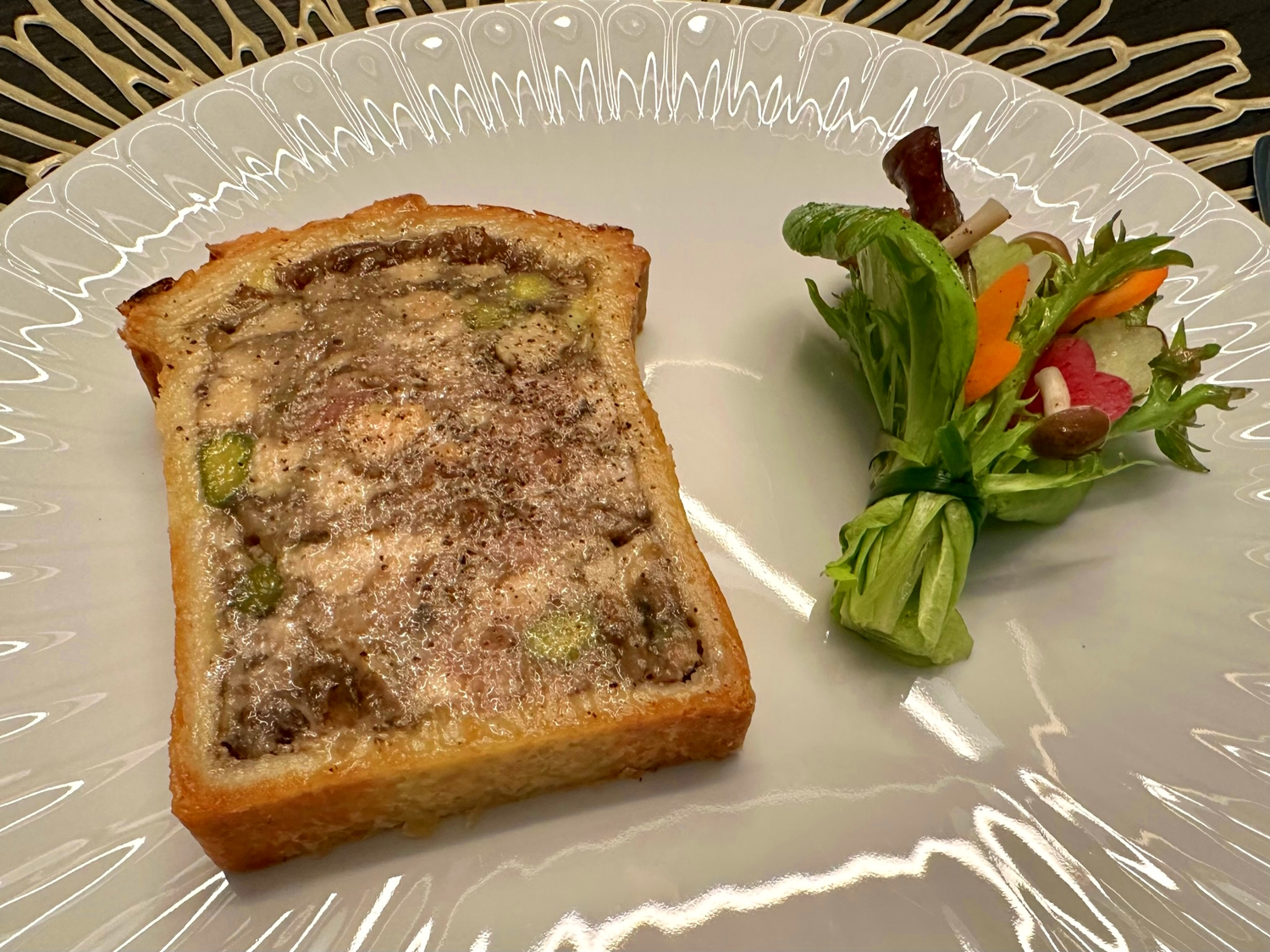
Clover Bellavita can seat up to 100 diners including the private rooms. In comparison, Piège’s fine dining flagship restaurant in Paris only serves 25 diners. Clover Bellavita is probably larger than necessary and it is not a haute cuisine restaurant. But it is certainly too fancy to be just a bistro. While Clover Bellavita has some dishes that are more bistro-like, they are all elevated in terms of presentation, number of components, and technique. For instance, the foie gras mousse is in the shape of a beautiful mandarin orange. The taste was wonderful, especially with a touch of acidity from the marmalade. The Pâté en croûte is well made with great ingredients and the presentation is elevated with the beautiful bouquet of vegetables on the side. The Steak au poivre is served with a tuile on top of the steak, and comes with a steak tartare on fried tendon topped with black pepper ice cream on the side.


The menu has a few large format dishes which I really appreciate. They bring the pleasure of sharing with friends at the table. These are especially nice to have when the weather is a bit colder because the food stays hot longer. One of the dishes is Poule au Pot, which is hearty and delicious. The diners are first served a foie gras caillette in broth, followed by a large pot of chicken and vegetables in broth. The chicken thighs and legs are very good. The breast meat is a bit tougher but that is to be expected. The vegetables are vibrant and cooked perfectly. The broth is simply wonderful. It is interesting to note that rice is not served on the side as Piège does in Paris. Instead a small portion of mashed potato with hazelnut is served on the side. The mashed potato is well made but it is problematic in relation to the chicken. Eating the whole chicken takes time. While the hot broth keeps the chicken parts warm, the mashed potato gets cold relatively quickly. Ideally the servers would bring out fresh servings of the mashed potato as one progresses with eating the chicken. My friends and I have also tried the Chou Farci (for four persons), a more refined version of a traditional French dish, and it is simply wonderful. Some fresh black truffle shaved table side only upped the luxuriousness. Having the large format dishes at Clover Bellavita is highly enjoyable. I wish more restaurants in Taipei would offer similar dishes. Why eat little dainty food of a tasting menu when you can have these glorious large dishes?


Besides the variations and modernizations of French classics, Clover Bellavita has some dishes that show Piège's imagination and creativity. The mark of a good chef is the ability to create his or her own combinations of ingredients and flavors and generating emotions from the diners. One of my favorites is the squid carbonara, a play on the Italian Pasta Carbonara. Instead of pasta, Piège uses thin slices of squid. This dish only has a few ingredients, but the combination, technique, and playfulness created something really magical. Another dish I enjoyed is a sticky corn soup with smoked eel and foie gras. Again, a dish with interesting combinations of ingredients with great flavors. There is also the langoustine with consommé. The langoustine is cooked table side on a heated Parisian granite paver. The use of stone brings a certain flair but it is more than just a gimmick. The stone’s porosity absorbs the fat used for the cooking. While the stone stays hot, it also cooks the langoustine slowly. For Piège, the technique is a modern variation of doing a stew.


There are five desserts on the menu at Clover Bellavita and the selections change periodically. I am particular fond of the Blanc à Manger, a truly wonderful creation that only has four ingredients: milk, egg, sugar, and vanilla. The dessert is a variation on Île Flottante. But instead of the meringue floating on the custard, Piège places the custard on the inside of a cylindrical meringue. The dessert looks so simple yet it is very technical. This is a signature dessert of Piège and is also served at his haute cuisine restaurant in Paris. The dessert connects Piège to his grandmother, who made an Île Flottante that formed Piege’s first memory of food. Île Flottante is a classic French dessert that everyone in France would know. To see Piège transforms the classic dessert into a very refined and new version is very exciting. The same can be said for another dessert on the menu, Raw Apple Tarte Tatin, which is a very interesting variation on the French classic Tarte Tatin. Recently, Clover Bellavita has been serving another classic, Crêpes Suzette with Grand Marnier and confit orange. I love the modern takes on these classics. The combination of ingredients are familiar but allows the diners to experience them anew. And they are delicious. Many classic French desserts are not to be found in restaurants in Taipei. So it is so wonderful to see references to them at Clover Bellavita. While Piège’s versions can certainly be enjoyed without the knowledge of the classics, the diners would probably appreciate the desserts a lot more if they do.


Some of the desserts, such as the Blanc à Manger, are very simply plated and not large in portion. They seem to be more suited as an ensemble and for the tasting menu format. For the diners who order à la carte and enjoy eating desserts, one dessert doesn’t seem quite enough. I almost wish I could order a set of desserts like at Pierre Gagnaire. After the dessert, a trio of mignardises are served, which are a nice way to end the meal.

The food at Clover Bellavita is consistently good. The main problem with Clover Bellavita is the service. On every one of my visits, there were problems with service. At a lunch with my family in the middle of January, no one took away the alcohol wipes after we used them; no one asked if we wanted more bread; no one, besides the Chef Périn, asked how was the lunch; no one asked if the sunlight was too bright and if the shades should be closed more; no one asked if we were still eating the soup with the chicken before taking the bowl away; no one asked if we wanted coffee or tea after the dessert; no one took away the salt and pepper mills before the desserts were served; no one asked if the alcohol in the chocolate petit four was okay for the kid; and no one paid attention to how our lunch was progressing. With the myriad of problems, the biggest one was the mignardises were brought to the table before I ordered the dessert. And instead of bringing three menus for the three of us to select the desserts, we shared one. The service at the end of the meal was just unprofessional. All this happened when the restaurant was not busy. I cannot imagine what happens when the restaurant is even half full.

The front of house team at Clover Bellavita is not well trained. Their movements in the dining room don't come naturally. They are stiff and not relaxed. When the servers seem tense, the diners don't feel as comfortable. While I can understand why the servers are all masked up, it doesn't help with engaging with the diners. You don't feel anyone is smiling behind the masks. The service team is also afraid to make mistakes which makes them more prone to making mistakes. At one of my dinners, the sommelier dropped a bottle of wine on the floor; luckily the bottle stayed intact and no one was hurt, but the wine was gone. The servers and managers lack experience and some of them are simply too young. As such, they don't have the abilities to read the diners and the situation. For instance, at one of my dinners, the server should have considered providing the bread before serving the cheese course; instead the diners had to ask for it. Good service is not just about bringing the food to the right person. Robots can do that and some restaurants are already using them. Service is about anticipating the diners’ needs and caring for them. At Clover Bellavita, I didn’t feel I was under the care of anyone. 

A diner expects good service at Clover Bellavita because the prices are not cheap. A three-course lunch costs NT$2,580 plus 10% service charge or around US$92. A full tasting menu is NT$5,980 plus 10% service charge or around US$215. Wines are prominently displayed in glass cabinets around the perimeter of the restaurant. The wine markup is not unreasonable, but it is certainly not a bargain. One of the wonderful things about Clover Bellavita is the diner can order à la carte. Very few western restaurants at this high level in Taipei offer the option of à la carte because it is more demanding on the kitchen and less economical. Appetizers are around NT$900 and main courses are around NT$1,300. The prices at Clover Bellavita is comparable to Piège‘s restaurants in Paris, besides Le Grand Restaurant. For instance, the Poule au Pot in Paris is 48 Euros per person, roughly NT$1,600, while in Taipei the dish is NT$1,639 per person. While the Poule au Pot in Paris is served in a bistro, the prices at Clover Bellavita make the restaurant more of a destination dining in Taipei. 

Clover Bellavita is a wonderful addition to the restaurant scene in Taipei. It is very nice to finally have another great French restaurant in Taipei besides L'Atelier de Joël Robuchon. In comparison to Robuchon, Clover Bellavita is actually more French. Robuchon has long adopted Asian ingredients and been influenced by Asian cuisine, especially Japanese. In contrast, Piège has said in the past that he is French, makes French food, and doesn’t use ingredients that don’t have a French identity such as Yuzu. Piège is more focused on modernizing French cuisine from within. 

I love having Piège‘s France in Taipei. We don’t really have anything remotely similar here. However, for a restaurant with an English name in an Asian city, one wonders how that will influence or change Piège‘s cooking in the future. What does it mean to use Taiwanese products to cook French food? Or for local servers to provide French service? The context for Piège‘s food in Taipei is completely different than in Paris. The typical diners in Taipei didn’t grow up with French food culture and are not as familiar with the classic dishes and the stories behind them. They won’t be able to connect with the food on an emotional level as Piège would have liked; there certainly won’t be any moment like the end of the movie Ratatouille. Nevertheless, Piège‘s food can certainly be enjoyed for their superb techniques, great flavors, and elegant presentations. Clover Bellavita is a great place to eat and It will be interesting to see how the restaurant develops as time goes on.

Thursday, February 18, 2021

Go to Town: Town by Bryan Nagao

Town by Bryan Nagao opened in 2018 in Taipei, but I didn’t set foot in the restaurant until late last year. The main reason was when the restaurant first opened, I heard conflicting reviews of the restaurant from friends and family; the negative outnumbered the positive ones. As the buzz died down after a few months of the opening, friends gradually stopped mentioning about Town. And I kind of forgot about the restaurant. 

In the summer of last year a friend asked me to join him for dinner at a newly opened restaurant in Taipei. Unbeknownst to me, chef Nagao was in my dining party. When Nagao sat down my friend said to me, “You must know Bryan”. Actually I didn’t and never tried his food. But I enjoyed eating with Nagao and told him I would visit his restaurant. In November I ate at Town for the first time. A couple of months later I went again and tried a slightly different menu. In short, I enjoyed both of my dinners.

Town is located on the third floor of a four-story building on Xinyi Road, diagonally across the street from the original Ding Tai Fung. The restaurant does not have an entrance directly off the street. But the signage on one of the doors of the storefront suggests there is one. The first time I was there I was confused as to how to enter the restaurant. To get to Town, one actually has to walk through the length of the ground floor cafe counter, pass the stairs going to the second floor, and look for a glass door on the left. The short corridor leads to a small elevator. The elevator door on the third floor opens to a transitional space that doesn’t engage the diners. The entire entry sequence is a bit awkward. 


The rest of the interior design is much better considered. Before getting to the receptionist stand, one walks past the open kitchen on the left. This is a nice feature. The guests get to meet chef Nagao at the green marble pass with the heat lamps and see how their food is made. As expected, the open kitchen is clean, bright and professional. The chef can welcome the guests before taking their seats in the dining hall, as if they are coming to his home. Nagao used to split his time between his restaurants in Hong Kong and Taipei. Since Town in Hong Kong closed in March 2019 and the pandemic hit in 2020, Nagao is spending all his time in Taipei. Therefore, when one walks into Town one is likely to see Nagao in the kitchen. 

The floor plan of the building consists of two structural bays of equal width. The public dining room occupies one bay and the two private rooms take up the other. Each bay has a balcony overlooking Xinyi Road. While I never see anyone on the balcony it is still nice to have floor to ceiling glass on one side of the room. The public dining room has a center aisle with seating on two sides. One side consists of three circular shaped green banquettes with round dark grey marble tables, while the other side has square tables and blue chairs set up for parties of four. The tables are nicely space. 

The various light fixtures in the public dining room are all in spherical glass shapes: wall mounted next to the square tables, table mounted in between the banquettes, and ceiling-hung above the receptionist stand. The three round tables each has an additional round metal lamp above them. The ceiling above the round tables even has circular alcoves that echo the shape of the banquette. The circular shapes are contrasted with the herringbone wood flooring. It is clear that a lot of thoughts were put into the design and the overall ambiance is quite pleasant. 


For both of my dinners I was seated at the first round table. The marble table and the lamp above have a retro feel as they reminded me of the Tulip table by Eero Saarinen and Arco lamp by Achille Castiglioni produced in the middle of the twentieth century. The silverware were placed on one side on a metal ledge. The table setting was pleasant but the placement of the menu was a bit awkward. The menu was tucked slightly under the top of the napkin. The napkin is folded into a rectangle with a width that matches the menu. The alignment of the menu and the napkin was clearly intentional but didn’t enhance the visual appearance of either. 


Town is open only for dinner and serves one menu for all the diners. The format is a tasting menu with nine courses plus amuse-bouches to start and mignardises to end. Four out of the nine courses have two different dishes for the diners to choose. The main savory course has three to four choices and carries different prices depending on the ingredients. As the season changes so does the menu. The menus at Town actually reminds me of the menus by Thomas Keller, which uses quotation marks pervasively. The menu refers and twists traditional flavors and technique. Any food lovers would be happy to read the menu that show the depth of Nagao’s knowledge and his ease of playing with the vocabularies of different cuisines. 

Dinner started with a couple of amuse-bouches. At my first dinner I was served a gougère and a waffle topped with foie gras mousse. The gougère was good but would be better if it was warmer; this is not easy as the puff is not large. The waffle was also good but a bit sweet. The flavor profile didn’t quite wake up the palette as I expected an amuse to do. In fact it dulled the appetite a bit. At my second dinner, the gougère appeared again, but the waffle was replaced by a crab tartlet topped with a sliced of black truffle. The crab was fresh and sweet and the truffle gave the flavor an earthiness. It was a delicious bite of food and made even better with a glass of champagne. 


After the amuse-bouches, a Parker House roll was brought to the table wrapped in paper. The bread was warm and served with smoked pistachio butter. I was happy to see an American bread. While the bread was nice, each diner got exactly one roll and no more. The bread plate was taken away after the bread was finished. The portion of the butter was generous and the flavor was interesting, but I wished there was more bread to spread it on. Perhaps Nagao is following the more recent trend at fine dining restaurants such as Per Se and Eleven Madison Park, where bread is listed on the menu, treated as a course, and each diner gets just one. 


Nagao didn’t seem to have a fixed format for the first course. At my first dinner it was a choice between lamb tartare or quail. At my second dinner it was scallop or red prawn. Some chefs set up their tasting menus with a first course that’s light, acidic, or with raw seafood, and then move into the heavier dishes. Nagao did not and instead produced dishes that were strong and full of flavors. For instance, the scallop I had was served with 36-month jamon from Cinco Jotas, chestnuts, and a soubise sauce. The dish was delicious and well made. The portion was small but just right; any bigger would be too heavy to start the dinner. 


The second course was a custard which Nagao produced different variations with different ingredients and sauces. The first one I had was with crab, oxtail marmalade, and onion jus. The second time it was with abalone, caviar and chicken jus. The custard is another good dish that was packed with flavors. The dish was also very beautiful especially with the blue bowl. The wooden spoon provided to eat the dish with was a nice break from the ubiquitous stainless tableware. 


However there was no pause on flavors. The third course that followed was a beef tripe and sweetbread with ragout. I like offal and I believe Nagao does as well. I enjoyed eating this dish. But I wouldn’t mind having some bread on the side to sop up the sauce. 

A soup was the fourth course. While I knew from the menu that it wasn’t something light such as a consommé or vegetable soup, I didn’t expect a full body bouillabaisse. At my two dinners, Nagao made the fish soup with different toppings; once with scallop and cauliflower, and the other with shirako and rouille. The soup was hearty and very flavorful. 


The fifth course was a pasta. There were two choices and one of them was uni tagliatelle that carried a supplemental charge of NT$220. The uni was served whole and sat on a small bed of pasta with slivers of jamon Iberico. I really enjoyed this dish, however I wished there were more pasta. On my second dinner I had a small bite of my dining companion’s uni pasta and it was a bit too salty. The ingredients, uni, Iberico ham, and cured pork fat were all salty to begin with so they could easily make the dish over seasoned. My friend’s pasta was also not hot enough. Since the pasta and the uni were not tossed in a hot pan, the temperature of the dish was not easy to control. This dish was really delicious when it was executed well. 


For my second dinner I tried the ravioli with peas and black truffle. The dish tasted as good as it looked. 


The sixth course was a seafood. At my first dinner I had an abalone with foie gras, house-made XO sauce, radish, and grapefruit. The dish was well executed and good but I wanted a bit more balance of flavors. 

The main savory dish was the seventh course. The portion for this dish was larger than the previous courses. There were three to four choices. The choice also determined the price of the entire dinner, ranging from around NT$2,480 to NT$2,880. Each of the main course also came with a side dish. I’ve tried three of the main courses and all of them were very good. At my first dinner I had the slow-cooked suckling pig, which was a reference to Kalua, the traditional cooking method in Hawaii. Since Nagao grew up in Hawaii, this could be considered a version of his hometown cooking. The pork was beautiful and reminded me of the Meat-Shaped Stone at the National Palace Museum. The side dish was a pork fat rice that was very delicious and reminded me of the rice dishes in Cantonese cuisine. 


At my second dinner I had the beef tongue with a side dish of beef cheek pie. It was another very nice dish that was well executed; just look at the sheen on all the sauces. However, the dish was almost a bit too much of a good thing. I wanted more contrast and balance to the high fat content of the beef tongue. I also ate half of my companion’s lobster with green Thai curry. My friend felt the lobster was under cooked, but I thought it was perfect. The flavor was interesting and very good. The side dish was a small lobster roll. All the main courses had many components and required a lot of work. They were well made and showed the range of Nagao’s cooking. Based on the main courses, it was hard to pin down Nagao’s style as he didn’t limit himself to any particular type of cuisines nor flavors. 


At both of my dinners I chose to have the wine pairing. There were two options and the prices were reasonable: 4 glasses for NT$1,280 or 6 glasses for NT$1,880. I enjoyed the conversations with the sommelier. She chose wines from a wide range of areas, including Alsace, Hungary, Austria, and Sicily; there was also sake from Japan. I agreed with her the wines from Alsace went well with Nagao’s food. I was happy to see her pour wines from Alsace and Austria because people in Taipei don’t drink enough from these regions; usually there’s too much focus on Bordeaux and Burgundy. 

The eighth course was a combination of a cheese course and pre-dessert. Similar to Thomas Keller, I suspect Nagao likes cheese and wants to serve it without bringing a whole cheese cart into the dining room. Instead of having a stand alone composed cheese course as Keller does at Per Se, Nagao combines the cheese with an ice cream or sorbet on top. This is an interesting idea that I don’t think I’ve encountered before. I had the Taleggio cheese and celery lemon sorbet and the Brie with black truffle ice cream. 


The last course was the dessert and both times I had the chocolate mousse flavored with Longan and served with grape sorbet. The flavors were wonderful and I liked the combinations. But the hazelnut chip on top of the mousse was crisp at the first dinner and less so on the second. After the desserts there were two mignardises to accompany the coffee or tea. The mignardises were well made and a nice way to end the dinner. 


The service at my two dinners was very nice and the experience was very pleasant. The noise level at the restaurant was not high and I felt comfortable lingering at the restaurant. 


One of the problems with Town is consistency. I had the uni pasta and the chocolate dessert at two separate dinners and the qualities ranged from great to so-so. Perhaps there were simply too many components in the dinner and the ambitions of Nagao were not matched by the capabilities of his staff. Nevertheless I have a hard time understanding why Town is not in the Michelin Guide Taipei. Everyone knows that Michelin places a great emphasis on consistency. While this may preclude Town from getting a star, but surely Town deserves a Plate recognition. 

Dining at Town begs the question, are there too much flavors? This is a question I never imagined I would ask in Taipei. The diners in Taipei have a tendency towards blandness, demanding chefs to use less salt and less sugar. As such, often times there are simply not enough flavors. Town is just the opposite. From the first course to the last, Nagao doesn’t let up with the packing of flavors. And since his flavor profile tends towards salty, sweet, umami, and less on acidity and bitter, there is the danger of palette fatigue. The flavors are big and direct but after several courses one craves for more contrast, balance, and subtleties. 

It is also possible that some of the palette fatigue is my own doing. Like a moth to flame, when I see dishes with tongue, sweetbread, foie gras, jamon, and uni on the menu, I will order them. The two menus I had were also for the winter time and it was the season for heavier and more hearty food. 

When one eats at Town one gets Nagao’s personalities on the plates. Did every dish work and deliver the wow effect? Not necessarily. Were all the flavors engineered and balanced precisely? Not all the time. But what’s wonderful about Nagao is his unique ideas and interesting combinations of flavors that one won’t find elsewhere in Taipei. He uses his experience from different parts of the world and put his own spin on the different cuisines. He understands the culinary traditions but is not bounded by them. Call it fusion or whatever term one likes, Nagao is doing his own food and it is a very good thing.

Tuesday, June 30, 2020

It Is Not What It Is: RAW by André Chiang

The glass front door is still deceptively heavy. The transparency of the material belies the effort it takes to open the door and enter restaurant RAW. The disconnect between perception and reality does not end at the front door but continues throughout the experience of the meal. Eating at RAW is not what it seems to be.

I haven't been back to RAW in five years. The main reason is it is simply too hard to make a reservation, arguably the most difficult in Taipei. Under the direction of Taiwanese celebrity chef André Chiang, the dining room at RAW is always full. Even the Covid-19 pandemic and the ban on foreign tourists in Taiwan have not slowed the business down. The other reason I haven’t returned is I am ambivalent about my previous dining experience. I don’t feel the strong urge to dine at RAW again. Recently at the invitation of a friend I have finally returned to RAW to dine for the second time. 

RAW of 2020 is a different restaurant from five plus years ago when it first started. Now the restaurant has two Michelin stars instead of none. Does the restaurant provide a two-star dining experience? The price of the menu has almost doubled since the restaurant first started. Is a meal there now twice as good as my last visit? The answers to both questions are, in short, not really.

Stepping inside I see the interior hasn't changed much. The space is well maintained and everything still looks new. I still like the design except for the text by George Calombaris on the concrete wall near the entry. The space at the front of the restaurant remains empty but recently has found a new purpose: for diners to sit down, fill out their travel histories, and have their temperatures checked. 


While RAW still looks and feels the same as when it opened in late 2014, the circumstances have changed significantly. Five-plus years ago, Chiang was still cooking everyday and chasing Michelin stars at his eponymous fine dining restaurant in Singapore. RAW was just an outpost in his home country and designed to be a bistronomy. In 2016 Restaurant André received two Michelin stars in Singapore’s inaugural Michelin Guide. At that time, there were rumors that Chiang was originally slated to receive just one star. The rating was changed to two stars at the last minute due to the lobbying of the Singapore authorities. The story is unconfirmed but certainly intriguing.

In October of 2017, Chiang abruptly announced he was closing his flagship restaurant in Singapore and “returning” his Michelin stars. Moreover he was leaving Singapore and moving back to Taiwan. To signal his complete disinterest in the Michelin stars, Chiang even asked Michelin to exclude RAW from the upcoming 2018 Taipei guide. This request was strange given Chiang’s entire career and reputation were built on the associations with the Michelin Guide. His personal library in Singapore contained a collection of Michelin Guide of France spanning decades. Was Chiang really breaking up with Michelin?

Chiang knew how to play hard to get. To no one’s surprise, when Michelin launched the guide in Taipei, they ignored Chiang’s request and awarded RAW with one star. Thumbing his nose at Michelin didn’t have any negative effect; actually just the opposite. One year later in 2019, Michelin upgraded RAW to two stars and decided the restaurant is just as good as Restaurant André was in Singapore. 

In Singapore Chiang was working in the kitchen full-time and got two stars. In Taipei, he gets two stars even when he doesn’t even want any. Instead of being on his feet all day in Singapore, he just cooks for his mom and wife at his home in Yilan, an hour drive outside of Taipei. Chiang is a smart man and must be laughing all the way to the bank. He is the most famous Taiwanese chef in the world. Michelin in Taipei needs him. 

Moving from Singapore to Taiwan means RAW has become the main signature restaurant of Chiang. RAW is also a restaurant he almost never cooked in and still doesn’t. Since the restaurant’s opening, the person running the day-to-day operation has been his trusted Chef de Cuisine Alain Huang. Chiang simply designs the menu and Huang executes the dishes on his behalf. However, I am surprised at how little input Huang seems to have on the menu. After I finish my recent meal, I ask Huang about some of the decisions on the dishes, he seems to suggest they are all made by Chiang. 

There used to be only one menu at RAW, NT$1,800 for 8 courses and everyone ate the same dishes. The socialist nature of the restaurant is no longer present. Now there are three choices: NT$1,850, NT$2,680, and NT$3,500. The pricier menus come with more courses and fancier ingredients. Since a meal at the restaurant is so hard to come by, my friend and I opt for the most expensive menu. I want the whole experience. 

Prior to dining at RAW I have already saw the pictures of the dishes on many websites and publications. Just about all of them simply regurgitate the press release from the restaurant: how the new menu is all about the celebration of spring and the increasing awareness on sustainability. Chiang is a master of publicity and he knows the media in Taiwan love and crave access to him. The media in Taiwan are essentially his mouthpieces. They don’t question or review his food.

The eleven-course spring menu starts with a nice and delicate green strawberry tart. However, the season for strawberry in Taiwan is not in spring but winter. Why start the spring menu with an unripe strawberry? The accompanying ice has a nice and subtle flavor but is too much in terms of portion. After the third bite I am bored and don’t want to finish it.


The second dish is very interesting, a salmon collagen with wasabi presented in a cocktail dish with chopsticks. It’s a pretty dish. A cup of fish soup is served on the side. The texture and flavors are very good. 

The third course is an escabeche which is served in a small rectangular tin with a bread on the side. I only wish the restaurant would provide a bit more bread. Why not be a bit more generous? Escabeche is a dish that originated from Persia and is now commonly found in the Mediterranean coast of Spain. It is basically a way to preserve fish or meat in vinegar. Eating this dish reminds me of my trip to Barcelona. This is another nice dish with great flavors. However, I don’t know why escabeche represents spring or Taiwan. It feels like a dish that Chiang just wants to make.


After we finish the course, a loaf of bread is brought to the table. Since we order the most expensive menu, the bread is included. The bread seems to be the same as the one on my first visit and remains quite nice. I still don’t know whether the bread is made in-house or not. 

The fourth course is a salad with various spring leaves, seaweed, and mackerel served on the side. I enjoy the dish. The vegetables are fresh and delicious and the dressing is very flavorful. I am ambivalent about whether I need the mackerels or not. They are served on an ice pack inside a styrofoam-like bento box. The presentation is unappetizing. 


The next course is a cold pasta inspired by the Italian Spaghetti alle Vongole. Chiang makes the kitchen braid the pasta and the vegetable for a great visual effect. I don’t understand the use of almond cream which clashes with the marinated cockles. The dish looks better than it tastes and is designed to be on Instagram. The temperature of the dish is also not appealing.


As if one dish of vegetables is not enough to celebrate spring, the kitchen brings out another dish of vegetables; this time lukewarm instead of cold. The vegetables are topped with a truffle cream sauce, which I don’t understand at all. If the menu is an ode to spring, why use an ingredient from winter? Putting aside the idea of representing spring, where does one get good truffle at the end of April? Not from France, Italy, nor Australia. The scent of the truffle seems artificial. Would a world famous two-Michelin star chef choose to use truffle oil for a dish? 


After six courses, I am hoping to finally get a dish that is hot. But my wish does not come true. RAW is a restaurant of cold and lukewarm food. You will never hear the phrase, “be careful the plate is hot” from the server. The only food that is hot to the touch is the bread. But bread should not be served hot as it disguises the quality. Also anyone who makes crusty bread knows that the bread needs to cool down for the crust to develop. If a diner is eating hot bread in the restaurant it is because the kitchen has reheated the bread. 

The last two savory courses are both done with fresh pork. I wish the restaurant would not repeat an ingredient for a tasting menu. I suppose we can’t expect restaurants to be like the French Laundry where ingredients don’t repeat over the course of a meal. Moreover, while fresh pork is a meat the Chinese like to eat, it is not an ingredient associated with spring. Before the ubiquity of refrigerators, pigs were slaughtered in the winter and mostly cured to preserve for later. If RAW is suppose to be all about being in tune with the seasons, why not serve lamb or chicken that is more representative of spring?

The first pork dish is essentially a meatball. Every component is well executed and the plating is beautiful and photogenic as always. However, by the time the dish arrives on my table it is not hot enough. This is a disappointment as it reduces the enjoyment of the food significantly. 


The second pork dish is a play on the three layers of pork belly. Instead of an outside skin, a thick layer of fat, and lower portion of pink meat, there is only a layer of pork made from the pigtail. The other layers are made with Chinese yam and mozzarella. The “crackling” on the top is made with peanut which isn’t as nice as a real pork skin and just sticks to my teeth. The sauce is made with peanuts. And there is a dollop of mediocre caviar which seems to be there just to pad the price of the menu. On the side is a “salami” made with fig. It is as if Chiang is just messing with us on purpose. He knows full well that spring is a season for cured pork but he purposely makes it with an inverted flower. Again, the “salami” is more interesting in concept and appearance than taste. This last savory course is the only dish of the meal that I fail to finish. I don’t like it at all. The server says this is a way to eat less meat. But how about making the dish delicious so I will finish the food instead of wasting it. 


After the disappointment with the last savory course, the two desserts that followed can’t come fast enough. The first one is a study on tofu. The server brings over a large house-made tofu to the table, but that’s just a show piece presented to all the tables in the room. The second dessert is Chiang’s take on the traditional red “turtle” cake. The cake is delicious. Both desserts are excellent and I enjoy them very much. The last time I was at RAW, the dessert was a disappointment. This time the desserts are the highlights of the meal.


While the food at RAW has some high and low points, the service is substandard. RAW should be glad that the Michelin Guide doesn’t consider service as part of the criteria for awarding stars. When one dines at a Michelin two-star restaurant, one expects a certain level of professionalism. For instance, the services at the two-star restaurants Jean Georges or Daniel in New York City are impeccable. The front of house staff are not only experienced but very knowledgeable. In contrast, the servers at RAW feel like they either just graduated from culinary school or they are interns. They cannot even set the cutlery properly on the table. They are not trained and simply memorized a script to repeat to the diners. They also have zero awareness of the diner’s needs.


The servers are lackadaisical. My friend’s napkin falls on the floor, the server takes it away but doesn’t replace it. My sparkling water is refilled with flat. The drinking glass for the beer is removed before the bottle is emptied. The server asks to remove the bread before the main course. What’s the hurry? Does the dishwasher need to go home early? What if I want to sop up the sauce when the main course is served? The runner brings the food on a tray, but there is no server to deliver them to the table. This happens more than once. At the second time I ask the the runner to not wait for a server and just bring the food to the table. I hate to see the food idling and dying due to bad service. 

When the warm vegetable dish is brought to the table, I ask the server where does the truffle come from given we are at the end of April? She says she doesn’t know but would get back to me. A while later, she comes to our table to serve another dish and I ask her again about the origin. She only says the restaurant uses truffle from France, Australia and China. So I ask again where do you get the truffle in spring? Again, she says she would ask the kitchen. Towards the end of the meal, I ask the server for the third time and she still doesn’t know. I suppose this question is not part of a memorized script or it is some secret. Eventually the Chef de Cuisine comes to our table and says the truffles are not fresh but preserved in oil from the winter. He doesn’t explain why an ingredient associated with winter is required to prepare a menu for the spring. I am also tempted to ask don’t you have pre-shift meetings? Why don’t you train your staff to know where the food you are serving come from?

The menu of RAW changes with the seasons. Every time the change takes place it is like a cultural event in Taipei. If you hang around with hipsters, you probably will hear the phrase, “Have you tried this season’s menu at RAW?” Eating at RAW is similar to attending a fashion show to see the latest trends. The clothes on the fashion runways are often times styled more for effect and the media instead of wearability and beauty. The primary concern of the cooking at RAW is also for concepts and publicity instead of deliciousness. Unfortunately the spring 2020 menu at RAW does not express a coherent set of ideas. The dishes don’t form a good story nor celebrate the season. The diners at RAW are just paying money to participate in Chiang’s whimsical experiments. 

Chiang has become the face of the Taiwanese food scene. Promoted by everyone, including himself, Chiang is the golden boy and can do no wrong. But eating at RAW, I cannot help but wonder if this is just like “The Emperor’s New Clothes” by Hans Christian Andersen. The only difference is Chiang is not just the emperor but he is also the weaver. He is one of the smartest chefs in the world. He seems to be knowingly parading nonsensical food to the public. Every season the people await his new creations, snatch up the reservations, and applaud after the meals. 

This doesn’t mean RAW is a restaurant to be avoided. If I am a tourist coming from abroad, I would certainly want to eat at RAW to see what all the fuss is about. While I don’t like every dish, I do appreciate the creativity. Experimentation always comes with the possibility of failure. If one doesn’t fail then perhaps one is not daring enough. RAW remains an interesting place to have a thought-provoking meal. RAW is just not a place to have a delicious meal that makes you want to come back the next day to eat it again.