Google Analytics

Showing posts with label Dessert. Show all posts

Monday, June 5, 2023

Clover Bellavita by Jean-Francois Piège

Jean-Francois Piège is a famous chef not only in his home country of France, but amongst the foodies in Taiwan. Piège was the mentor of the celebrity Taiwanese chef, Lanshu Chen, at the Hôtel de Crillon in Paris. He came to Taiwan twice in 2013 and 2018 as a guest chef at Chen’s restaurant, Le Moût, in Taichung. Piège has also been promoted by a Taiwanese journalist based in Paris. When rumors of Piège's arrival in Taipei started before the COVID pandemic, it was certainly exciting. And the fact that a space one-floor below L'Atelier de Joël Robuchon at Bellavita sat empty only added to the intrigue. However, the pandemic had seemed to stop everything.

To my surprise, seemingly out of nowhere in mid-November, 2022, Piège arrived in Taipei to open the doors of his first restaurant outside of France, Clover Bellavita. This is Piège's fourth restaurant under the Clover brand. The name is an English word but is pronounced in the French way. Each Clover restaurant in France is based on a different concept. They are not fine dining but a bistro, a grill, and a vegetarian restaurant, places to diversify Piège's portfolio. But what is Clover in Taiwan? While Piège hasn't officially declared his aspiration for Clover in Taipei, as he did when he opened his flagship fine dining restaurant in Paris in 2015, it is safe to say he and his investors are looking for a Michelin star.

Over the course of many months, I have been to Clover Bellavita four times for both lunch and dinner. Based on the food on the plate, the restaurant should easily get one Michelin star. I've tried many dishes on the winter and spring menus, and all of them are wonderful. In fact, the restaurant is only getting better with time. However, my sentiment runs contrary to some other diners.

When Clover Bellavita first opened, it was panned by many diners with unfavorable comments and one-star reviews on Google Maps. While the worthiness of the comments on Google Maps is debatable, some of the negative sentiments have been corroborated by a few of my discerning friends.

But if one examines the disappointing reviews, many were made based on meals in the first few weeks of the restaurant's opening. While paying customers certainly have the right to express their unhappiness, the early days of a restaurant is not the best time to render a judgement. All restaurants simply need time to work out the kinks in the operation with real customers. This is similar to professional sports as practice is never the same as the actual game. Furthermore in this current time, restaurants are most likely to be understaffed in the beginning. The odds of a great experience at a newly opened restaurant are usually not good.

Another problem with Clover Bellavita was due to expectation created by the marketing, which often touted Piège as a three-Michelin-star chef. Some people came to expect three-Michelin-star food and service, which the restaurant clearly was not intended to provide. Moreover, Piège is not a three-star chef.

Piège might be the most acclaimed chef in France who doesn't yet have three stars. He has received many accolades, including two Michelin stars for his current fine dining restaurant in Paris, Le Grand Restaurant. Prior to striking out on his own, he worked for Alain Ducasse as the Chef de Cuisine at Plaza Athénée and garnered three Michelin stars. Two of his subsequent fine dining restaurants, at Hôtel de Crillon and at Hôtel Thoumieux, both received two Michelin stars. In 2011, his colleagues named him the Chef of the Year after a secret vote organized by Le Chef magazine. From 2010 to 2019, he was a member of the jury in the French version of Top Chef. He has published numerous cookbooks. Not only is he a media savvy chef, he is one of the most accomplished chefs of his generation.

It is a mystery why the third Michelin star eludes Piège. There was the rumor of his feud with Alain Ducasse, but that seems to be ancient history. Ducasse has published a book by Piège under his imprint in 2011. One possible explanation is that prior to opening his Le Grand Restaurant, he has never stayed in a place for more than 5 years. Michelin is probably loathe to give a chef three stars and see the chef leave for another restaurant shortly after. In comparison, this year's three-Michelin-star winner, Alexandre Couillon, has been at his restaurant for 24 years; it took Couillon ten years to be elevated from two-star to three-star. Besides changing locales, Piège is also constantly changing his cuisine. He has adopted the motto: pour que rien ne change, il faut que tout change (for nothing to change, everything must change). Michelin probably prefers more stability and consistency. 

Since Clover Bellavita is not in Paris, Piège cannot be as hands on with the restaurant. To execute his vision and uphold his standard, he has asked Gildas Périn to be the Chef de Cuisine. Périn is young but highly experienced. He has worked for Piège in Paris before, and prior to opening Clover Bellavita worked in two restaurants in Taipei: STAY by Yannick Alléno and Orchid; he understands the tendencies of the local diners. Perin is also a very skillful chef. As his team gains more experience, I am confident the food will only get better.

Unlike Piège’s restaurants in France, Clover Bellavita is not located on the street with a storefront. Rather the restaurant is on the 4th floor of Bellavita, the fanciest shopping mall in downtown Taipei. The interior of the restaurant befits the image and characteristics of the mall: fancy and spacious. The reception is a generously sized sunlit space with a beautiful red wall. Strangely, the red color doesn't relate to anything else in the restaurant. The tent-like ceiling of the reception is interesting, but doesn’t seem to go with the rest of the space either. The reception leads to a curved bar with white countertop and orange bar chairs. In the center of the shelves behind the bar sits a big espresso machine. The shelves behind the bar are mostly filled with wine bottles and glasses. This bar isn’t really set up for cocktail making and doesn’t seem to get much use from the guests.


The bar forms one side of the main dining room. Two other sides of the room has large windows that allow ample natural light to come in, which is nice especially at lunch time. The space is structured spatially by two stone-clad circular columns, an off-centered circular step-down ceiling, and circular patterned flooring. The center of the space is a small table with a large floral piece that changes regularly; a very pleasant visual element that is probably costly to upkeep. Surrounding the center piece are tables with arm chairs and sofas that are nicely spaced apart. The chairs are comfortable but the sofa is a bit low in relation to the height of the table. The biggest eyesores are the electrical sockets for the floor lamps on the four corners. They are not flushed with floor nor under the sofa, thus are potential tripping hazards. There are a few floor-standing rattan screens in the space but they don't seem to relate to the furniture. While there doesn't seem to be a coherent idea about materials and colors, overall the space is still quite pleasant.


Piège certainly cares about aesthetics of the table setting. The black tabletops in the main dining room are shiny and reflective. In lieu of tablecloth, there are several types of round placemats by Chilewich in two different colors. The water glasses for the diners at the tables also come in different subtle colors. Every table has a small vase with flowers. I am also happy to see every table has a pair of salt and pepper mills. Some of the dinnerware is from the Ecume collection by Bernardaud and others are custom made; they are all very elegant. The silverware are also pretty and comfortable to use. The only thing I don’t like is the size of the napkin, which is too small for a fancy restaurant.

The restaurant has three private dining rooms. The large one can seat around 16 diners and has a view of the pastry station of the kitchen. The two smaller rooms, both with windows, can each seat around 8 people and each has its own private bathroom. However, the bathrooms are raised instead of being flushed with the floor; they are not wheelchair accessible. This is similar to the bathroom for the main dining room. The owner of the restaurant probably couldn't access the floor beneath so the drain pipes have to run above the slab. This is most unfortunate as one has be quite careful exiting the restrooms, especially after a few drinks. Since the ceiling in the restaurant is high, one wonders if the designer should have simply elevated the whole restaurant or large parts of the dining room. 

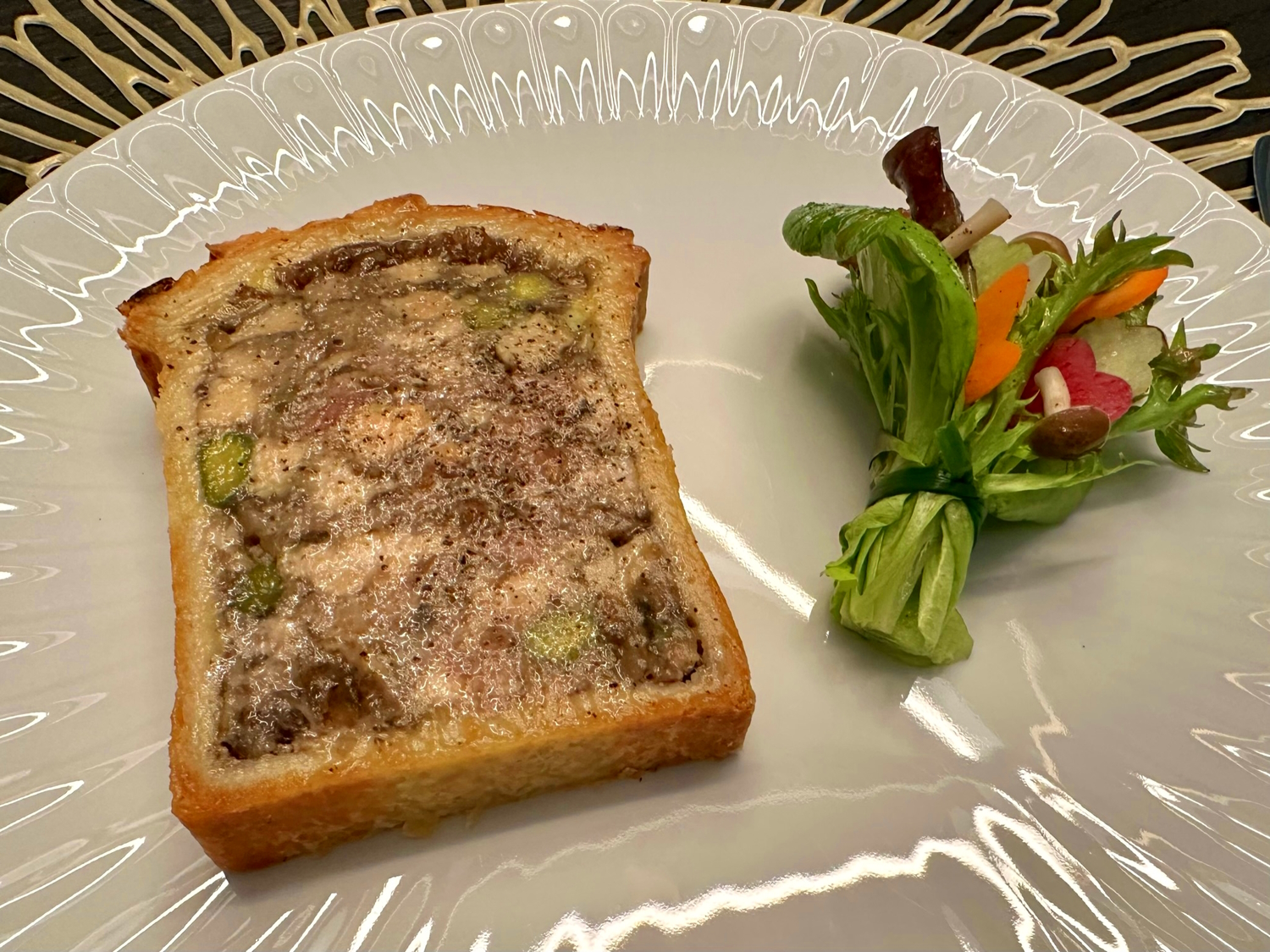
Clover Bellavita can seat up to 100 diners including the private rooms. In comparison, Piège’s fine dining flagship restaurant in Paris only serves 25 diners. Clover Bellavita is probably larger than necessary and it is not a haute cuisine restaurant. But it is certainly too fancy to be just a bistro. While Clover Bellavita has some dishes that are more bistro-like, they are all elevated in terms of presentation, number of components, and technique. For instance, the foie gras mousse is in the shape of a beautiful mandarin orange. The taste was wonderful, especially with a touch of acidity from the marmalade. The Pâté en croûte is well made with great ingredients and the presentation is elevated with the beautiful bouquet of vegetables on the side. The Steak au poivre is served with a tuile on top of the steak, and comes with a steak tartare on fried tendon topped with black pepper ice cream on the side.


The menu has a few large format dishes which I really appreciate. They bring the pleasure of sharing with friends at the table. These are especially nice to have when the weather is a bit colder because the food stays hot longer. One of the dishes is Poule au Pot, which is hearty and delicious. The diners are first served a foie gras caillette in broth, followed by a large pot of chicken and vegetables in broth. The chicken thighs and legs are very good. The breast meat is a bit tougher but that is to be expected. The vegetables are vibrant and cooked perfectly. The broth is simply wonderful. It is interesting to note that rice is not served on the side as Piège does in Paris. Instead a small portion of mashed potato with hazelnut is served on the side. The mashed potato is well made but it is problematic in relation to the chicken. Eating the whole chicken takes time. While the hot broth keeps the chicken parts warm, the mashed potato gets cold relatively quickly. Ideally the servers would bring out fresh servings of the mashed potato as one progresses with eating the chicken. My friends and I have also tried the Chou Farci (for four persons), a more refined version of a traditional French dish, and it is simply wonderful. Some fresh black truffle shaved table side only upped the luxuriousness. Having the large format dishes at Clover Bellavita is highly enjoyable. I wish more restaurants in Taipei would offer similar dishes. Why eat little dainty food of a tasting menu when you can have these glorious large dishes?


Besides the variations and modernizations of French classics, Clover Bellavita has some dishes that show Piège's imagination and creativity. The mark of a good chef is the ability to create his or her own combinations of ingredients and flavors and generating emotions from the diners. One of my favorites is the squid carbonara, a play on the Italian Pasta Carbonara. Instead of pasta, Piège uses thin slices of squid. This dish only has a few ingredients, but the combination, technique, and playfulness created something really magical. Another dish I enjoyed is a sticky corn soup with smoked eel and foie gras. Again, a dish with interesting combinations of ingredients with great flavors. There is also the langoustine with consommé. The langoustine is cooked table side on a heated Parisian granite paver. The use of stone brings a certain flair but it is more than just a gimmick. The stone’s porosity absorbs the fat used for the cooking. While the stone stays hot, it also cooks the langoustine slowly. For Piège, the technique is a modern variation of doing a stew.


There are five desserts on the menu at Clover Bellavita and the selections change periodically. I am particular fond of the Blanc à Manger, a truly wonderful creation that only has four ingredients: milk, egg, sugar, and vanilla. The dessert is a variation on Île Flottante. But instead of the meringue floating on the custard, Piège places the custard on the inside of a cylindrical meringue. The dessert looks so simple yet it is very technical. This is a signature dessert of Piège and is also served at his haute cuisine restaurant in Paris. The dessert connects Piège to his grandmother, who made an Île Flottante that formed Piege’s first memory of food. Île Flottante is a classic French dessert that everyone in France would know. To see Piège transforms the classic dessert into a very refined and new version is very exciting. The same can be said for another dessert on the menu, Raw Apple Tarte Tatin, which is a very interesting variation on the French classic Tarte Tatin. Recently, Clover Bellavita has been serving another classic, Crêpes Suzette with Grand Marnier and confit orange. I love the modern takes on these classics. The combination of ingredients are familiar but allows the diners to experience them anew. And they are delicious. Many classic French desserts are not to be found in restaurants in Taipei. So it is so wonderful to see references to them at Clover Bellavita. While Piège’s versions can certainly be enjoyed without the knowledge of the classics, the diners would probably appreciate the desserts a lot more if they do.


Some of the desserts, such as the Blanc à Manger, are very simply plated and not large in portion. They seem to be more suited as an ensemble and for the tasting menu format. For the diners who order à la carte and enjoy eating desserts, one dessert doesn’t seem quite enough. I almost wish I could order a set of desserts like at Pierre Gagnaire. After the dessert, a trio of mignardises are served, which are a nice way to end the meal.

The food at Clover Bellavita is consistently good. The main problem with Clover Bellavita is the service. On every one of my visits, there were problems with service. At a lunch with my family in the middle of January, no one took away the alcohol wipes after we used them; no one asked if we wanted more bread; no one, besides the Chef Périn, asked how was the lunch; no one asked if the sunlight was too bright and if the shades should be closed more; no one asked if we were still eating the soup with the chicken before taking the bowl away; no one asked if we wanted coffee or tea after the dessert; no one took away the salt and pepper mills before the desserts were served; no one asked if the alcohol in the chocolate petit four was okay for the kid; and no one paid attention to how our lunch was progressing. With the myriad of problems, the biggest one was the mignardises were brought to the table before I ordered the dessert. And instead of bringing three menus for the three of us to select the desserts, we shared one. The service at the end of the meal was just unprofessional. All this happened when the restaurant was not busy. I cannot imagine what happens when the restaurant is even half full.

The front of house team at Clover Bellavita is not well trained. Their movements in the dining room don't come naturally. They are stiff and not relaxed. When the servers seem tense, the diners don't feel as comfortable. While I can understand why the servers are all masked up, it doesn't help with engaging with the diners. You don't feel anyone is smiling behind the masks. The service team is also afraid to make mistakes which makes them more prone to making mistakes. At one of my dinners, the sommelier dropped a bottle of wine on the floor; luckily the bottle stayed intact and no one was hurt, but the wine was gone. The servers and managers lack experience and some of them are simply too young. As such, they don't have the abilities to read the diners and the situation. For instance, at one of my dinners, the server should have considered providing the bread before serving the cheese course; instead the diners had to ask for it. Good service is not just about bringing the food to the right person. Robots can do that and some restaurants are already using them. Service is about anticipating the diners’ needs and caring for them. At Clover Bellavita, I didn’t feel I was under the care of anyone. 

A diner expects good service at Clover Bellavita because the prices are not cheap. A three-course lunch costs NT$2,580 plus 10% service charge or around US$92. A full tasting menu is NT$5,980 plus 10% service charge or around US$215. Wines are prominently displayed in glass cabinets around the perimeter of the restaurant. The wine markup is not unreasonable, but it is certainly not a bargain. One of the wonderful things about Clover Bellavita is the diner can order à la carte. Very few western restaurants at this high level in Taipei offer the option of à la carte because it is more demanding on the kitchen and less economical. Appetizers are around NT$900 and main courses are around NT$1,300. The prices at Clover Bellavita is comparable to Piège‘s restaurants in Paris, besides Le Grand Restaurant. For instance, the Poule au Pot in Paris is 48 Euros per person, roughly NT$1,600, while in Taipei the dish is NT$1,639 per person. While the Poule au Pot in Paris is served in a bistro, the prices at Clover Bellavita make the restaurant more of a destination dining in Taipei. 

Clover Bellavita is a wonderful addition to the restaurant scene in Taipei. It is very nice to finally have another great French restaurant in Taipei besides L'Atelier de Joël Robuchon. In comparison to Robuchon, Clover Bellavita is actually more French. Robuchon has long adopted Asian ingredients and been influenced by Asian cuisine, especially Japanese. In contrast, Piège has said in the past that he is French, makes French food, and doesn’t use ingredients that don’t have a French identity such as Yuzu. Piège is more focused on modernizing French cuisine from within. 

I love having Piège‘s France in Taipei. We don’t really have anything remotely similar here. However, for a restaurant with an English name in an Asian city, one wonders how that will influence or change Piège‘s cooking in the future. What does it mean to use Taiwanese products to cook French food? Or for local servers to provide French service? The context for Piège‘s food in Taipei is completely different than in Paris. The typical diners in Taipei didn’t grow up with French food culture and are not as familiar with the classic dishes and the stories behind them. They won’t be able to connect with the food on an emotional level as Piège would have liked; there certainly won’t be any moment like the end of the movie Ratatouille. Nevertheless, Piège‘s food can certainly be enjoyed for their superb techniques, great flavors, and elegant presentations. Clover Bellavita is a great place to eat and It will be interesting to see how the restaurant develops as time goes on.

Sunday, January 13, 2019

Bencotto with Iacopo Frassi: The Mind and the Heart of Italian Cooking and Eating

"Because the French cook with their brains, it's intellectual. Look at the Italians, it's from the heart, isn't it? It's more emotional, and that's the difference between the two cuisines," remarked the great British chef Marco Pierre White. The observation is an oversimplification of the two cuisines, but there certainly are differences; just consider the French cuisine's tendency to recreate natural forms versus Italian's indifference towards imitating nature. However, since France and Italy share a border, most of the cuisines in the two countries fall between the two extremes. In making the claim, perhaps White was merely reflecting on himself as having the best of both worlds. He was born by an Italian mother but professionally trained by the French; even his names Marco and Pierre are a combination of the two languages. White's claim triggers a question in my mind, is the best kind of chef a combination of opposite approaches? In other words, is good cooking ultimately about finding a balance between the mind and the heart?

The question kept surfacing on my mind when I ate the food prepared by chef Iacopo Frassi at Bencotto, the Italian restaurant at Mandarin Oriental Taipei. Frassi took over Bencotto as the Chef de Cuisine in the late summer of 2018. The main concept of Frassi's cuisine is declared on Bencotto's website: "contemporary interpretation of timeless Italian culinary heritage". This statement seems to be a mind bender since the idea of timelessness is antithetical to modern re-interpretation. Nevertheless, Frassi is keen to creating new Italian cuisine by reworking the classics. This is a significant shift from the previous iterations of Bencotto, which touted itself as a place for "Home-cooked Italian Cuisine". There is a re-balance of the mind and the heart.

The previous chef of Bencotto, Loris Pistillo, has moved back to Seoul after less than two years in Taipei. Pistillo's cooking was simple and graceful. While Pistillo wasn't a traditionalist, he wasn't overtly trying to re-conceptualize Italian cuisine. The cooking felt from the heart. To emphasize the heart of Italian cooking, twice during his tenure, Pistillo even invited his mother Angela to make pasta at Bencotto. The pastas were delicious and everything one imagines Italian cuisine to be; truly the Italian nonna-style. As one ate the pasta, one didn't think about the need to re-invent Italian cuisine.

New ideas may be good and interesting, but they are not necessarily better or more delicious. Given that traditions in Italian cuisine are so strong, attempts to create new Italian dishes are extremely challenging. In contrast to Pistillo, Frassi is more of a risk taker and as such, the rewards might be bigger but so are the pitfalls. Notwithstanding, Frassi's food is more intriguing and poses more questions than answers for the minds of the diners.

Frassi is a young chef, not even 30 years old. He hails from Tuscany, Italy. Prior to coming to Taipei, he spent almost two years as the chef de cuisine at the Italian restaurant in the Four Seasons Hotel in Tianjin, China. The short stay in Asia hasn't impacted his cooking significantly yet. His cooking mainly reflects his training in Europe. It probably won't come as a surprise that Frassi not only trained with Italian chefs in Italy, but with a French chef. In his formative years, he was a chef de partie at Alain Ducasse's three-Michelin-star restaurant in London. The connection with France goes beyond Frassi himself. Frassi's masters in Italy also trained with French Michelin-star chefs: Antonio Guida with Pierre Gagnaire and Giuseppe Mancino with Alain Ducasse. While it is hard to quantify how much the French way of cooking and thinking have influenced Frassi, his cooking is different from a chef trained solely in the Italian traditions.

Since Frassi took over Bencotto, I have dined at the restaurant five times on various occasions: lunch with business associates, dinners with family and friends, dinner with a large group, with and without Frassi in the kitchen. I didn't like everything I ate. In fact my first time at the restaurant under his helm, I came away a little disappointed. I wondered to myself, did I order the wrong dishes? But in subsequent visits, I have increasingly come to like the food more. Perhaps I am starting to understand what the chef is trying to do.

Frassi proposed his first menu in October of 2018. Several dishes on the previous menu, more representative of traditional and simple Italian food, are no longer present; the salumi platter, mozzarella salad, pizza, panna cotta, have all disappeared. The new menu is more concise, and organized in the familiar four-course Italian cuisine of starter, pasta, main course and dessert. While many dishes on the menu sound familiar, such as Polpo e Patate, Astice alla Catalana, Diavola, Rossini, and Carbonara, they are not what they seem to be. Each of these classic dishes have been re-imagined.

Instead of the traditional Pollo alla Diavola seasoned with cayenne pepper, Frassi replaces the chicken with the more luxurious saddle of lamb. The meat is topped with a spicy pesto and a rustic Ndjua sauce. The Astice alla Catalana is enhanced by a corn sauce poured table side in addition to the lobster sauce in the middle. The combination of corn and lobster reminds me of the flavors in American cuisine. The presentation is quite elegant and is certainly not your average lobster tartare. These dishes show that Frassi has a tendency towards complexity by layering condiments with sauce or having two sauces in one dish. While I enjoyed these two dishes, some of Frassi's other twists of traditional dishes didn't work as well.


A dish that was more interesting in concept than in taste was the Ravioli alla Carbonara. The idea seems to be derived from the combination of two Italian classics: Spaghetti Carbonara and Tortellini en Brodo. Instead of coating the pasta on the outside with carbonara sauce, the egg mixture is encased inside. Instead of chicken stock, the soup is infused with pancetta. While there are only a few ingredients, the dish felt a bit much, mainly because of the combination of two types of sauces of different viscosities. The ravioli with a sauce inside is almost a bit like a soup dumpling. I don't think another soup is necessary on the outside.


For a ravioli dish I prefer Frassi's two-tone ravioli with shrimp and lemon. This dish is more complex than the Ravioli alla Carbonara, yet the taste has more clarity and is very nice.


Another dish that I understand in concept but not in taste is Baccala alla Rossini. As the name suggests the dish is inspired by the French classic Tournedos Rossini: filet mignon topped with seared foie gras and served with truffle and Madeira sauce. Instead of beef, Frassi reimagines the dish with black cod. Besides the classic ingredients, he adds the local spice Sebastan Plum Cordia (破布子), which the Taiwanese uses with steamed fish. Instead of crouton, the local vegetable under the dish provides a little crunch. The flavors are not balanced enough and taste is too sweet. Perhaps my palette is biased, but I don't like seafood with sweet sauce. While in the classic Rossini the filet is tender, the black cod is more tender, making the overall texture of the dish too soft. The use of local ingredients are nice, but they didn't really work for me. The dish seems too disconnected from Italy. My impression is Frassi thought too much about the concept of the dish and made it too complicated. Creativity and deliciousness don't aways go hand in hand.


I prefer the other fish dish on the menu, Dal Giappone alla Toscana, red garoupa with eggplant miso chutney, pickled vegetables, and Cacciucco sauce. While miso is not a traditional ingredient in Tuscany, the use of eggplant, pickled vegetable, and the Italian fish stew sauce certainly evokes Italy.


There are two risotto on the menu One is a reference to the ingredients of pizza while the other is with seafood. While both risotto are well executed, I prefer the one with seafood. The Risotto alla Pizzaiola looks fun and is a more interesting idea in terms of presentation. But at the same time, the effect is more forced and actually feels less Italian. Perhaps one of the reasons I like the seafood risotto better is the use of more luxurious ingredients of oyster, sea urchin and red shrimp; the dish is much more expensive. I also like the fact that the rice is served table side, and covered the seafood in a more natural and casual manner. It is as if the chef is saying the ingredients are good enough that he isn't worrying about the presentation.


One of Frassi's signature dishes on the menu is the Piccione Toscano. Just based on the appearance, one can tell this pigeon main course requires a lot of skills in the kitchen. While this is a multi-component dish that is complex, I like it. The pigeon is cooked very well and is very tasty. The only problem is with the small bites, the food doesn't stay hot enough.


Sometimes when Frassi doesn't overthink the dishes, the results are wonderful as in the main course Manzetta Tartufata, Australian Wagyu beef striploin with morel mushrooms, black truffle, and licorice mayonnaise. The beef is cooked well and the flavors are great.


Another spectacular dish at Bencotto is the pumpkin gnocchi with chestnut, cheese, and white truffle. The flavors of the seasonal ingredients go well together. And there is a simplicity and heartiness to the dish that make it deeply satisfying.


One problem I encountered over the many meals at Bencotto was the inconsistency in the the seasoning for the savory courses. A beef dish I had was a bit salty while the Osso Buco that accompanied the risotto was a bit under-seasoned. I suspect the reason is the chef hasn't been able to calibrate to the palette of the local diners. While I have a high tolerance for salt, most local diners do not. Many feedback from the local diners in the earlier months of the chef's tenure probably were about saltiness of the food. This issue happens to many foreign chefs when they first arrive in Taiwan, but will likely be resolved as time passes.


Desserts at Bencotto are more delicate now than before. I enjoyed a dish named Bianco Mangiare, or Eat White. The name doesn't reference another dish in Italian cuisine. As such I can simply enjoy the yogurt mousse, pine nuts, banana gelato, and crispy yuzu as the taste themselves. The white crisps are broken in pieces of different sizes and geometry that don't feel fussy, yet produce a sense of mystery that is nice.


In contrast, the dessert called Il Tiramisu is less interesting, and consists of a Mascarpone sphere with a quenelle of Italian espresso gelato, and pieces of sponge cake (perhaps made with the Albert Adrià microwave technique). The Tiramisu at Bencotto is technically more sophisticated than a classic Tiramisu, but not as satisfying to eat. The great thing about the classic Tiramisu is the sum is better than the parts. Together the mascarpone, sugar, egg, ladyfingers and cocoa powder create a bite of flavor that is magical. By separating the Tiramisu into distinctive parts, the presentation is elegant, but the taste is not better than the messy classic version. Once the components are separated, the Tiramsu loses its raison d'être. Bencotto’s version begs the question, at what point is the reference to the classic dish no longer valid or necessary?


In the four years that Bencotto has been in operation, many mid-range Italian restaurants have opened in Taipei: La Mole, Il Mercato, La Locanda, Botega del Vin, Cantina del Gio, Di Vino...etc. While the food and decor of these restaurants are not as posh as Bencotto, they are also not as expensive. In terms of value to the diners, the gap between them and Bencotto is not that far apart. This is perhaps one of the reasons that the management of Mandarin Oriental Taipei has decided to re-orient Bencotto as a fine dining restaurant. Another reason might be the arrival of the Michelin Guide in the spring of 2018. The hotel wants another star restaurant to bolster its standing as the best in Taipei. Bencotto already has the infrastructure for a fine dining restaurant: a fancy interior, a dedicated sommelier, and an experienced front of house team. The management of the hotel has also eliminated the buffet lunches on the weekend; I can finally go to Bencotto for lunch on the weekend again. The repositioning of Bencotto has already paid dividend as the restaurant was awarded one fork by Gambero Rosso in November of 2018.

A meal at Bencotto now starts with a trio of appetizing amuse-busches. This is followed by an excellent house-made bread served with a choice of three olive oils and two types of balsamic vinegars. Furthermore, when the bread and bread sticks are placed on the table, the server spritzes from a bottle made by Antonella Bondi to simulate the smell of freshly baked bread. The food fragrance is fun but a bit forced and gimmicky.


As with a Michelin-star restaurant, the meal ends with a trio of mignardises, which are all very good.


Elevating the food also means elevating the prices. The main courses at Bencotto used to average around NT$1,000. Now they are around NT$1,600 and with a pigeon dish exceeding NT$2,000 (around US$67). While not as expensive as the three-Michelin-star Italian restaurant in Hong Kong or at Frassi's mentor's restaurant in Milan, some of the prices at Bencotto are not too far off from other Michelin-starred Italian restaurants. For instance, a main course of striped bass or halibut at the two-Michelin-star Marea in New York City costs around US$58 (including tax and tip) or NT$1,800. The main course of garoupa at Bencotto is NT$1,738 (including service charge). A four-course meal à la carte at Bencotto now can easily run over NT$4,300 inclusive of the 10% service charge (around US$140): with a appetizer at NT$980, pasta at NT$880, main course at NT$1580, and dessert at NT$480.

Instead of ordering a la carte, the better way in terms of cost may be to go with the set menu at lunch time. The three-course lunch of appetizer, main course, and dessert is NT$1,488. All the dishes in the à la carte menu can be selected and are just served at smaller portions. There are no supplemental charges. So for anyone looking for the best value, just order a foie gras terrine to start, followed by the pigeon as the main course, and chocolate cake as the dessert.

The service at Bencotto has improved from the last time I wrote about the restaurant. Part of the reason has to be members who have been there since the opening have gained more experience and grown with the job. The sommelier Alex Tsai has also been at Bencotto since the opening. He has always been very professional and seems more relaxed now. I enjoy talking to him about wines.

The wine list at Bencotto has expanded and even received an award from Wine Spectator magazine. However, the wines at Bencotto are still too expensive. For instance, some of the bottles at Bencotto are more expensive than the three-Michelin-star restaurant Per Se in New York City. Consider a bottle of Barolo Carobric 2001 by Paolo Scavino. At Bencotto the price is NT$12,500 (including service charge), and at Per Se the same bottle is around NT$11,000 (including service charge and tax). The Barolo Brunate 2009 by Vietti is NT$16,500 at Bencotto and NT$15,800 at Per Se. Per Se has one of the highest mark-ups for wines in New York City, and it is unthinkable for Bencotto to be more expensive.

The prices at Bencotto are crazier if one compares them to restaurants less fancy than Per Se. For example, a bottle of the non-vintage Billecart-Salmon Brut Rose is NT$10,120 at Bencotto and around NT$7,600 at the two-Michelin-star Italian restaurant Marea in New York City. A bottle of Barolo 2013 from Pio Cesare is NT$9,350 at Bencotto, but NT$4,950 at a fine dining French restaurant in Taipei. The Pio Cesare Barolo 2013 can be purchased at icheers.tw, an online wine store in Taiwan for NT$2,635 (15% off the retail list price). Assuming Mandarin Oriental can buy the same bottle at wholesale price, the markup at Bencotto for the bottle is around 400%. Why do the prices at Bencotto have to be so high? I understand the need to mark-up wines at a restaurant, but at least do it at a reasonable rate that I can swallow.

​The corkage fee at Bencotto is NT$1,000 per bottle. The corkage fee at Per Se is around NT$4,600 (US$150). If Bencotto’s prices for wines are more expensive than Per Se, why not charge the same for corkage? The restaurant is basically encouraging the local diners to bring their own wines. I am not a tuhao (土豪) nor do I like bringing wines to a restaurant with a sommelier. Therefore, I usually just order a wine by the glass with my meal at Bencotto. It's unfortunate the pricing at Bencotto discourages the diners to order and enjoy the wines by the bottles.

While the cuisine and service at Bencotto have evolved, the physical environment has changed very little since I wrote about the restaurant four years ago. The uncomfortable chairs at the tables surrounding the center piece in the backroom are still there. The awkwardly located sitting area remains unoccupied by guests. At least the flat screen TV showing Italian football is thankfully no longer present (hidden behind the cabinet doors). The wine tasting room near the back entrance is now set up as a semi-private dining room. Previously this room with a beautiful wall of wines behind glass was just be a space to be admired rather than used. While the interior of Bencotto is nice, there is room for adjustment. After four years in operation, it is clear that some of the intended purposes and functions in the original design didn't pan out. And since the service at Bencotto is changing with the food, for instance more carts are wheeled around the dining room, it is time to rethink the interior layout. This may require more time, after all physical environment is more difficult to change than the menu.

Bencotto is in a period of transition. The restaurant is changing for the better and moving in the right direction, but it is not there yet. Frassi is a young chef but someone with passion and technical prowess. He is still developing his style. The desire to go beyond the classics and to create new dishes is necessary. After all, what is a classic but an invention that worked? The road to making new classics are paved with failed experiments. Re-inventing Italian cuisine is especially difficult because many iconic Italian dishes are so delicious and entrenched in people's minds, that often times the new dishes feel too foreign or pale by comparison.

Italian cuisine always seems to project a sense of tradition and an authenticity that does not change. However, this is not entirely true. Many things in Italian cuisine that we deem as sacred are not historical but modern inventions. For instance, Spaghetti Carbonara is not a dish from the 19th century but rather an invention from the 1950's. The Tiramisu was first created in the 1960's. The Ciabatta bread that we often see in Italian restaurants all over the world was created in the 1980's. None of these things are in Pellegrino Artusi's iconic book on Italian cuisine, Science in the Kitchen and the Art of Eating Well, published in the late 19th century.

Whether old or new, Italian cuisine is about finding the balance between creativity and simplicity. The mind and the heart are not always compatible. Frassi's cooking right now seems more conceptual than visceral. Many of the dishes are too complicated with too many components. The techniques and capabilities of the cooks are impressive, but they don't necessarily increase the level of deliciousness. Some of the dishes make references to the classics, but I don't know if the connections are necessary. By framing the dishes via the classics, the diners' reactions are bounded; diners are asked to intellectualize the dish (connect the dots) rather than react from the heart. However, eating is not always a rational act but also an emotional one. At Bencotto, I find myself wanting to just enjoy the food without thinking about them too much. The restaurant doesn't quite allow me to do that yet, but it is a very interesting place to dine. I am curious to see how Bencotto will evolve.

Sunday, January 10, 2016

The Sweet Side Awakens

"Hi, I am Julien Perrinet and I am the pastry chef at the Grand Hyatt Taipei." Last October, by chance I found myself sitting next to the friendly French chef at the counter of L'Atelier de Joël Robuchon Taipei during dinner. As Perrinet introduced himself, I thought to myself: Grand Hyatt? The only times I step into the Hyatt are for weddings or the annual Ivy Ball. The food at these events are at best harmless. Besides the tickets to the Ivy Ball (not really Ivy nor a Ball), it has been years, perhaps decades, since I spent any hard earned money in the Hyatt.

To be fair, people often forget that the Grand Hyatt is the first large international hotel in Taipei. When the hotel opened over twenty-five years ago, it represented the standard of excellence in the city. Not only was the Hyatt the place to go for a fancy meal or event, it was also the premier training ground for the people in the hospitality industry. For instance, across the counter at L'Atelier de Joël Robuchon where I sat, many senior managers had stints at the Grand Hyatt. However, in recent years the Hyatt seems to have fallen off the radar. The hotel is still grand but there doesn't seem to be any excitement that warrants a visit.

"I moved from Singapore to Taipei in May. I was part of the Robuchon team when the restaurants in Singapore opened." This explains why Perrinet was friendly with the visiting Robuchon team. As our dinner in October progressed, I asked Perrinet whether he would make any special pastries for the upcoming Christmas holidays. The question was answered with series of resounding yeses: Bûche de Noël? Yes; Galette des Rois? Yes. With the féve? Yes, of course.

The questions probably struck Perrinet as strange since he wouldn't think otherwise. I asked because Christmas is not an official holiday in Taiwan and there isn't a strong sense of the Christmas spirit in Taipei. Some of the good pastry shops in town, such as Sweet Tea by Yannick Alleno at Taipei 101, don't make any holiday items anymore. As I departed from the L'Atelier after another lovely meal, I told Perrinet that I would visit him at the Hyatt when the holiday arrives.

"I considered several places before deciding to join the Grand Hyatt. The hotel gives me a lot of responsibilities and I also have a pastry shop in the lobby to play with." Since around March of 2015, the hotel replaced its souvenir shop on the ground floor with a pastry shop/bakery called the Baguette. I wonder if this new shop is a response to Mandarin Oriental's Cake Shop on the other side of town.

The choice of "Baguette" as the name for the shop is very odd since the French bread is just one of the many items for sale. The name suggests the importance of the bakery. Hence at my first visit to the shop I bought a croissant to try. The croissant was not good at all. The shell was not crisp nor brittle and didn't shatter when one bit into it – a real disappointment. In a subsequent visit I asked the salesperson if Perrinet was in charge of the Viennoiseries, and she said no. The bakery and the pastry are produced by two different departments. Furthermore, the main attraction of the shop seems to be Perrinet's creations in the glass display case, which are the first things one sees.


"We have four kinds of Bûche de Noël for you to choose from." The salesperson at the Baguette responded when I called to ask and order the Christmas log cake in December. While other shops made one signature Bûche de Noël, Perrinet made Mosaic (chocolate praliné), Firework (pineapple-coco), Red Noël (raspberry litchee rose), and Chestnut (with pear and cinnamon). Over the phone I asked for the Red Noël and was told I had to pay first. Taken aback, I said, "you don't trust that I will pick up the cake later today? You have my name and mobile number and that's not enough?" In response, she said, "There were a few instances where customers ordered and didn't show up. The cakes are perishable and we need preorder to be prepaid by fax." I can't help but think the Cake Shop at the Mandarin Oriental doesn't ask me to prepay. Annoyed, I almost hung up the phone. Perhaps she sensed my unhappiness, and said I don't have to prepay if I pick up the cake within the next three hours.

The weather in last December didn't feel like winter at all, and as usual there weren't too many Christmas decorations around town. But as I walked inside the Hyatt to pick up the Christmas cake, I saw the Baguette was decked out in probably the most impressive gingerbread house in Taipei. With four types of Bûche de Noël, multiple Christmas themed pastries, and a gingerbread house big enough to walk through, Perrinet may be the most enthusiastic pastry chef in Taipei. Perrinet is also a very skilled pastry chef. The Red Noël cake was large and attractive – well suited for a party. The taste was very good, with the sweetness balanced by a bit of acidity from the fruits.


"Did you order the Galette des Rois?" My kids knew that I always buy one for the Epiphany; I don't know the verses in Matthew 2:11 well, but I know pithivier. They were also eager to try their luck again to see if they can add another fève to their collection. Maybe because I'm not a believer, in the years that I bought the Galette, I have never gotten the fève and the chance to wear the crown. 


The Galette des Rois at the Grand Hyatt was made with Isigny butter. The 7-inch version was NT$520 plus $100 for the porcelain fève. The price seemed very reasonable. I love puff pastry and frangipane thus the Galette des Rois is one of my favorite things to eat. Perrinet made the Galette with care and in the traditional manner. It was just delicious. Our family quickly devoured the cake. Similar to previous years, I didn't get the piece with the fève inside. My Catholic wife was the queen this year; as Psalm 37:18 states: The Lord takes care of those who obey him.


"The Canelé at the Hyatt was one of the reasons that I decided to join the hotel. During my job interview I saw that they made the Canelé in the traditional manner with the beeswax and copper mold. I knew there was a good foundation to build upon." Perrinet told me during our dinner last October. Indeed, the Canelé at the Hyatt is very good with a crunchy and well caramelized exterior with a chewy and soft interior. At NT$50 the large Canelé is a very nice treat. 

Perrinet changes the contents in the glass display case frequently in response to the seasons. Since strawberry is in season now he has made a few new pastries. They are not only good to eat but will surely bring a smile to anyone who sees them.


There has been an awakening in the sweet side of the Grand Hyatt. Anyone who visits the shop at the hotel lobby will definitely feel it. I love Perrinet's enthusiasm and passion, and I hope they won't diminish as he familiarizes with the local customers. I am eager to see how Perrinet's creation will evolve as he spends more time in Taipei. Furthermore, will the rise of the sweet side lead to a renewal of the bakery? Will the Grand Hyatt return to the forefront of the dining scene in Taipei? Hopefully more episodes await.