From time to time, I would buy an issue of Monocle magazine to read. I enjoy reading the stories and, besides, I like the look and the physical feel of the magazine. Recently I decided to purchase a one-year subscription, which is ten issues for £75. The great thing about Monocle is it doesn't matter where one lives in the world, the subscription rate is the same. Tyler Brûlé, the founder of Monocle, said, "We didn't think you should be penalized because of where you live.”
In certain parts of the world, unlike a typical magazine, it is actually more expensive to subscribe to Monocle than to purchase the issues at the newsstand. For instance, in London, the subscription cost per issue is £7.5 versus the newsstand price of £5; in the U.S., the subscription cost per issue is around US$12 while the newsstand price is US$10. Fortunately, in Taipei, the situation is reversed, where a subscription cost per issue is around NT$350 and the newsstand price is NT$550. Since I am always looking for opportunities to "save" money, I signed up and spent £75.
Google Analytics
Tuesday, March 22, 2011
Tuesday, March 8, 2011
147.2°F Eggs
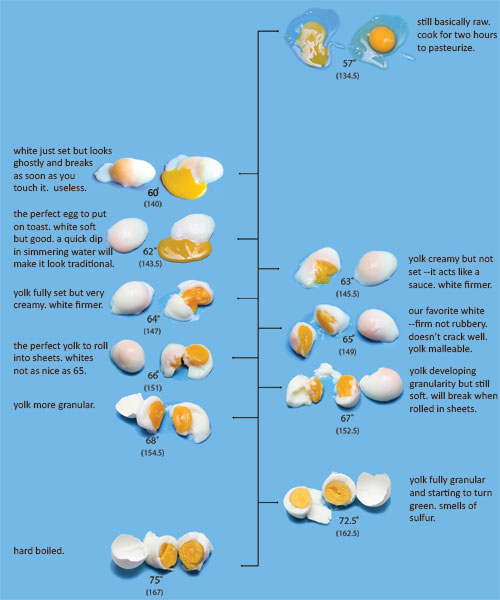
For my first attempt at sous vide cooking, I used Thomas Keller's recipe of Soft-Boiled Egg with Toasted Brioche and Bacon Marmalade in the booklet that came with the equipment. Technically, eggs are actually not cooked sous vide since they come with their own shells and don't need to be vacuum packed.
The recipe calls for cold eggs to be cooked in a water bath at the temperature of 147.2°F or 64°C for one hour. The circulator is very precise as it maintains the cooking temperature with ± 0.2°F stability.
While the eggs were cooking, I made the bacon marmalade: pan-fried minced bacon with blanched diced onions, cooked in a mixture of reduced vinegar and honey. I also toasted a store brought brioche.
I took the eggs out of the water after an hour. I cracked the shells open on one end and slipped the eggs out into a small bowl. Then with a large spoon the eggs were transferred very gently onto a plate. I also tried to make a quenelle of the marmalade and placed it next to the eggs.
The egg white is soft but relatively firm. The yolk is set yet very creamy.
The precision and consistency provided by the immersion circulator is really quite amazing. The blog, Cooking Issues, actually has a chart showing the results of eggs cooked at different temperatures. Now I understand why chefs are so enamored with sous vide cooking.
The recipe calls for cold eggs to be cooked in a water bath at the temperature of 147.2°F or 64°C for one hour. The circulator is very precise as it maintains the cooking temperature with ± 0.2°F stability.
While the eggs were cooking, I made the bacon marmalade: pan-fried minced bacon with blanched diced onions, cooked in a mixture of reduced vinegar and honey. I also toasted a store brought brioche.
I took the eggs out of the water after an hour. I cracked the shells open on one end and slipped the eggs out into a small bowl. Then with a large spoon the eggs were transferred very gently onto a plate. I also tried to make a quenelle of the marmalade and placed it next to the eggs.
The egg white is soft but relatively firm. The yolk is set yet very creamy.
The precision and consistency provided by the immersion circulator is really quite amazing. The blog, Cooking Issues, actually has a chart showing the results of eggs cooked at different temperatures. Now I understand why chefs are so enamored with sous vide cooking.
Saturday, March 5, 2011
Arbitrage: Le Beurre Bordier
Ever since my lunch at Caprice in Hong Kong, where they use Bordier butter for the bread service, I have been wanting to buy some to use at home. The butter by Jean-Yves Bordier is often considered to be the best. The butter is made from organic cream of grass-fed cows, folded and tempered by handheld wooden paddles.
Just out of curiosity I did a google search and, to my surprise, it is actually available in Taiwan via 博客來. Unfortunately, the price is ridiculously high: NT$235 for 125g of butter.
In Hong Kong one can buy 250g of Bordier butter for HK$58, in other words, roughly NT$110 for 125g; less than half of what it costs in Taiwan. Of course it is still the cheapest to buy the butter in France, where the price for 125g is around 1.8 euro or NT$73.
I love Le beurre Bordier, but I cannot justify paying more than three times the price in Paris or double the price in Hong Kong. So, no gourmet butter for me anytime soon.
In Hong Kong one can buy 250g of Bordier butter for HK$58, in other words, roughly NT$110 for 125g; less than half of what it costs in Taiwan. Of course it is still the cheapest to buy the butter in France, where the price for 125g is around 1.8 euro or NT$73.
I love Le beurre Bordier, but I cannot justify paying more than three times the price in Paris or double the price in Hong Kong. So, no gourmet butter for me anytime soon.
Tuesday, March 1, 2011
Lung King Heen 龍景軒
Lung King Heen 龍景軒 in Four Seasons Hotel in Hong Kong is the first Chinese restaurant to be awarded three stars by the Michelin guide. Ever since then there has been endless debates on whether the restaurant deserves the ultimate distinction. In a certain way, it doesn't really matter. If Michelin says it is three-star then it is; after all it is Michelin's stars anyway.
Nevertheless, all the chatter on the web certainly piqued my interest. When we visited Hong Kong recently, Maria and I went for lunch with our two young kids. Normally when we go to a fancy restaurant, we leave the kids at home. However, on Lung King Heen's website, it said, "Lung King Heen is delighted to welcome families with children aged 3 and above." I was too happy to oblige and this would be our kids first three-star experience.
The restaurant is located on the fourth floor of the hotel. The room is nicely designed with tables and chairs nicely spaced; a very comfortable environment. We were seated at a table adjacent to a silk clad column, near the window with a fantastic view of Kowloon.
We had a starter of barbecued suckling pig and roast pork; both were excellent. The rest of the lunch, we mostly ordered off the dim sum menu, that included baked turnip puff, baked abalone with diced chicken puff, steamed rice roll with lobster, steam shrimp dumpling, and crispy spring roll. Every dish was very refined, well executed, and simply delicious.
The service was not only impeccable but also friendly and relaxed.
Lung King Heen is the first kid-friendly Michelin three-star restaurant that I have been to. It is such a treat for a young family to enjoy a high quality meal together. In a certain way, this befits the Chinese culture, where dining is often a family affair and about sharing and eating together. Unlike fancy French restaurants, where one often don't see kids, or one has to ask the kitchen to do something simple. At Lung King Heen, we didn't even have to order anything off the menu for the kids. They thoroughly enjoyed their wonton shrimp noodle soup, the stir-fried vegetable, as well as the roast pork.
We finished the meal with two desserts that we all shared. The server also brought out a plate of mignardises, which our kids probably ate more than us. Below is Ava enjoying her share:
The meal at Lung King Heen was not cheap, but it was a thoroughly enjoyable experience, especially as a family. Frankly, I have no problem with Michelin's rating. It was delicious and extremely pleasant.
Nevertheless, all the chatter on the web certainly piqued my interest. When we visited Hong Kong recently, Maria and I went for lunch with our two young kids. Normally when we go to a fancy restaurant, we leave the kids at home. However, on Lung King Heen's website, it said, "Lung King Heen is delighted to welcome families with children aged 3 and above." I was too happy to oblige and this would be our kids first three-star experience.
The restaurant is located on the fourth floor of the hotel. The room is nicely designed with tables and chairs nicely spaced; a very comfortable environment. We were seated at a table adjacent to a silk clad column, near the window with a fantastic view of Kowloon.
We had a starter of barbecued suckling pig and roast pork; both were excellent. The rest of the lunch, we mostly ordered off the dim sum menu, that included baked turnip puff, baked abalone with diced chicken puff, steamed rice roll with lobster, steam shrimp dumpling, and crispy spring roll. Every dish was very refined, well executed, and simply delicious.
The service was not only impeccable but also friendly and relaxed.
Lung King Heen is the first kid-friendly Michelin three-star restaurant that I have been to. It is such a treat for a young family to enjoy a high quality meal together. In a certain way, this befits the Chinese culture, where dining is often a family affair and about sharing and eating together. Unlike fancy French restaurants, where one often don't see kids, or one has to ask the kitchen to do something simple. At Lung King Heen, we didn't even have to order anything off the menu for the kids. They thoroughly enjoyed their wonton shrimp noodle soup, the stir-fried vegetable, as well as the roast pork.
We finished the meal with two desserts that we all shared. The server also brought out a plate of mignardises, which our kids probably ate more than us. Below is Ava enjoying her share:
The meal at Lung King Heen was not cheap, but it was a thoroughly enjoyable experience, especially as a family. Frankly, I have no problem with Michelin's rating. It was delicious and extremely pleasant.
Monday, February 14, 2011
Sous Vide: The Pressure Starts
Ever since I bought Thomas Keller's Under Pressure a few years ago, I wanted to try some of the recipes in the book. However, cooking sous vide requires buying some new equipment that were either very expensive or not readily available to the average consumer. Recently, PolyScience came out with an immersion circulator that is sold at Williams-Sonoma; the store also sells an accompanying vacuum sealer. With the new tools in hand, I am finally ready to do some low-temperature cooking.
Friday, February 11, 2011
Battle Egg Tarts
Before I went to Hong Kong, I read that there are two places to go for egg tarts: Tai Cheong Bakery 泰昌餅家 and Honolulu Coffee Shop 檀島咖啡餅店. Since the two stores make their egg tarts differently, some people prefer one over the other. When I did a quick survey amongst my friends who are familiar with Hong Kong, the verdict was split. Therefore, I decided to visit both places and to see which egg tart reigns supreme.
The two stores are located a few blocks from each other: Tai Cheong is at 35 Lyndhurst Terrace, Central 中環擺花街35號 and Honolulu Coffee Shop is at 33 Stanley St, Central 中環士丹利街33號
Tai Cheong is a just a bakery store without any seating and there always seem to be a line out the door. It is not a long wait, less than ten minutes or so.

Unlike the traditional egg tart, Tai Cheong uses a shortcrust pastry as the shell. The unique butter cookie-like crust provides more contrast in texture to the soft filling. We bought half a dozen to sample back at the hotel and they were really good.
Since Honolulu Coffee Shop has seating, we simply went and ordered some egg tarts with a few milk teas. The egg tarts here are made more in the traditional method with Chinese puff pastry.
The two stores are located a few blocks from each other: Tai Cheong is at 35 Lyndhurst Terrace, Central 中環擺花街35號 and Honolulu Coffee Shop is at 33 Stanley St, Central 中環士丹利街33號
View Hong Kong Eats 2010 in a larger map

Unlike the traditional egg tart, Tai Cheong uses a shortcrust pastry as the shell. The unique butter cookie-like crust provides more contrast in texture to the soft filling. We bought half a dozen to sample back at the hotel and they were really good.
Since Honolulu Coffee Shop has seating, we simply went and ordered some egg tarts with a few milk teas. The egg tarts here are made more in the traditional method with Chinese puff pastry.
The egg tarts are also really good. The puff pastry is light and crispy and the custard is creamy. They were just delicious.
So which one did I like better? I am going to cop out and say I like both. I can't decide.
Friday, February 4, 2011
Dinner with Chef Angelo Aglianò
When my brother and sister-in-law came back to visit from the U.S. in early January, we decided to treat them to dinner at my favorite and, in my opinion, the best western restaurant in town: L'Atelier de Joël Robuchon Taipei. This would be our first dinner with the new chef, Angelo Aglianò, who took over from Chef Yosuke Suga late last year. Chef Aglianò has made some changes to the menu and I was eager to try some new dishes. In short, the kitchen was firing on all cylinders and the dinner was amazing.
Since we were a party of six, the restaurant preferred that we pre-order to facilitate the service. As with before, instead of the six of us picking individual dishes, I asked the chef to just cook for us; we would all have the same menu. This time, a couple in my party had some diet restrictions - no raw seafood and no crab. Unlike before, we sat at a table instead of at the bar as a couple in my party insisted. It is true that with a party of six, it is easier to have conversations sitting across each other than spread out along the bar. However, one is a bit detached from the actions in the kitchen.
For this blog entry I actually have pictures of some of the dishes we had. The pictures were all taken by my sister-in-law with her iPhone. While she took pictures of all the dishes, some of them didn't turn out too well due to the low lighting conditions.
The Chef started us off with an amuse-bouche of a mousse topped with nuts and mushroom signaling the arrival of winter in Taipei. There was also the excellent bread basket that I always enjoy.
The first course consisted of three things: a small salad, caviar topped with gold leaf, and a scallop. The scallop was beautifully seared with a nice caramelized outer surface. The sweetness of the scallop paired well with the saltiness of the caviar, and the salad provided a bit of contrast.
As with my previous visit, I asked the sommelier Benoît Monier to pick the wine for us. It is always fun to talk to Benoît and learn a bit more about wines. This time I found that his Chinese vocabulary has increased dramatically; I am afraid pretty soon, his Chinese is going to be better than my French.
The second course was a risotto with saffron topped with some red shrimps and fresh herbs. First of all it was a visually attractive dish with vibrant colors of yellow, red, and green. The rice was not only cooked to the proper chewy texture but with the creamy consistency that is all'ongda.
The fish course was a filet of amadai that was perfectly cooked with crispy scaled skin. Instead of serving the fish in a yuzu and lily bulb broth as Chef Suga used to do, Chef Aglianò served the fillet with a light mint sauce and pea purée. I must say I like both versions equally. The scales gives the dish a nice crunch. Benoît joked the dish was a play on the English fish and chip with mint peas.
The meat course for the night was a free range chapon from Landes. A chapon is a castrated rooster which is more tender and flavorful. The chapon was prepared as a ballotine stuffed with dates confit and candied chestnuts, served with a light sauce, vegetables, and a small herb salad on the plate, and the famous mashed potato, this time with truffle shavings, on the side. It was simply a delicious and elegant dish with great flavors; a dish not often seen anymore. As my brother said, the dish shows the chef has great fundamental techniques and he cooks with finesse. It was just a pleasure to eat the dish.
Since we were a party of six, the restaurant preferred that we pre-order to facilitate the service. As with before, instead of the six of us picking individual dishes, I asked the chef to just cook for us; we would all have the same menu. This time, a couple in my party had some diet restrictions - no raw seafood and no crab. Unlike before, we sat at a table instead of at the bar as a couple in my party insisted. It is true that with a party of six, it is easier to have conversations sitting across each other than spread out along the bar. However, one is a bit detached from the actions in the kitchen.
For this blog entry I actually have pictures of some of the dishes we had. The pictures were all taken by my sister-in-law with her iPhone. While she took pictures of all the dishes, some of them didn't turn out too well due to the low lighting conditions.
The Chef started us off with an amuse-bouche of a mousse topped with nuts and mushroom signaling the arrival of winter in Taipei. There was also the excellent bread basket that I always enjoy.
The first course consisted of three things: a small salad, caviar topped with gold leaf, and a scallop. The scallop was beautifully seared with a nice caramelized outer surface. The sweetness of the scallop paired well with the saltiness of the caviar, and the salad provided a bit of contrast.
As with my previous visit, I asked the sommelier Benoît Monier to pick the wine for us. It is always fun to talk to Benoît and learn a bit more about wines. This time I found that his Chinese vocabulary has increased dramatically; I am afraid pretty soon, his Chinese is going to be better than my French.
The second course was a risotto with saffron topped with some red shrimps and fresh herbs. First of all it was a visually attractive dish with vibrant colors of yellow, red, and green. The rice was not only cooked to the proper chewy texture but with the creamy consistency that is all'ongda.
The fish course was a filet of amadai that was perfectly cooked with crispy scaled skin. Instead of serving the fish in a yuzu and lily bulb broth as Chef Suga used to do, Chef Aglianò served the fillet with a light mint sauce and pea purée. I must say I like both versions equally. The scales gives the dish a nice crunch. Benoît joked the dish was a play on the English fish and chip with mint peas.
The meat course for the night was a free range chapon from Landes. A chapon is a castrated rooster which is more tender and flavorful. The chapon was prepared as a ballotine stuffed with dates confit and candied chestnuts, served with a light sauce, vegetables, and a small herb salad on the plate, and the famous mashed potato, this time with truffle shavings, on the side. It was simply a delicious and elegant dish with great flavors; a dish not often seen anymore. As my brother said, the dish shows the chef has great fundamental techniques and he cooks with finesse. It was just a pleasure to eat the dish.
After the main course, a pre-dessert of grape sorbet with grappa flavored mousse and jelly was served.
The dessert was a molten chocolate cake with coffee mousse and milk ice cream. As always the dessert is an architectural composition of different rounded shapes with contrasting flavors, textures, and temperatures. The chocolate tuile and different nuts provided nice accents to the dish. It was a beautiful dish, extremely satisfying for a chocolate lover like me.
As usual the dinner ended with a macaron and for me a double espresso.
The service, led by Vincent Hsu, the manager, was impeccable and relaxed. The courses were also well paced.
Every course of the dinner was excellent. All of us were extremely happy with this memorable meal. Before we left we chatted briefly with Chef Aglianò, who is just a very warm and engaging person; his personality and generosity really come through with his dishes. I hope to go back as often as I can.
Thursday, February 3, 2011
Tuesday, February 1, 2011
Arbitrage: Lawry's
Recently good friends of ours treated us to Lawry's Taipei. It was actually my first time in a Lawry's. I followed my friends' suggestion and ordered the 7.5 oz English Cut: three thin slices of roast beef served with a salad, mashed potato and Yorkshire pudding. I quite enjoyed the roast beef, which was prepared simply and served without much fanfare. According to my friend, the quality of the meat in Lawry's Taipei is not too far off from the branch in Los Angeles.
While I can't compare the restaurants in terms of taste, I can play a little game of arbitrage and compare the prices. In the U.S., the English Cut is US$34, and adding the sales tax and the service charge, the total cost is around US$43 or around NT$1270. In Taipei, the total cost of the same dish, including 10% service charge, is NT$1650; quite a premium. At least the cost is about the same as the branch in Hong Kong, where the English Cut is HK$451 (410 plus 10% service charge) or around NT$1680.
Subscribe to:
Posts (Atom)